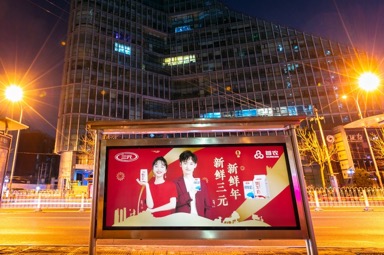
Is it your first time advertising at a bus stop? The complete guide for 2026 covers point selection, lightbox specifications, and monitoring and acceptance.
2026-04-10Tianci MediaViews:119
Highlights
Is it your first time advertising at a bus stop? The complete guide for 2026 covers point selection, lightbox specifications, and monitoring and acceptance. Tianci Media is a professional public transportation advertising platform that helps you reach mainstream urban audiences at low cost. Click to get the practical guide.
Every morning and evening rush hour, the bus stop is filled with people waiting for the bus, with an average wait time of 3-8 minutes.
This is the value of advertising placement at bus stops - low cost, high frequency, and strong reach.
1、 Why is bus stop advertising worth investing in? (Still established in 2026)
Long dwell time: The average waiting time for public transportation is 4-9 minutes, which is longer than subway platforms and elevators.
Wide coverage: from students to the elderly, the coverage is extremely wide.
Flexible location: precise selection of locations based on commercial districts, residential areas, schools, and hospitals.
Low cost: It can be launched for tens of thousands of yuan and is the "first choice" for offline advertising.
2、 6 Steps for Advertising Placement at Bus Stations (2026 Edition)
Step 1: Clarify the advertising target and audience
Example of crowd site matching:
Target mother → Bus stop near kindergarten and elementary school
Target white-collar lunch → Surrounding stations of office buildings, with increased lighting during lunchtime
Target community elderly → Bus stop at the entrance and exit of large residential areas
Step 2: Choose the media format for bus stop advertising
Characteristics of Form in 2026
Most lightboxes (large) have been upgraded to LED digital lightboxes, which can be remotely updated
Light box (small) above the station sign, simple logo+phone
The new electronic station sign supports video playback, reaching the waiting crowd
The roof of the bus shelter is visible from a distance and suitable for regional landmark advertising
Novice advice: Start with standard bus shelter lightboxes (digital or static).
Step 3: Filter specific sites
Four Step Method for Station Selection (2026):
Define geographical range: 3-5 kilometers around the store.
Mark high-value locations: commercial districts, schools, hospitals, large communities.
Evaluate passenger flow quality: prioritize selecting bus shelters with seats and avoid obstructions.
Data validation: Use the station passenger flow heat map provided by the platform.
Step 4: Prepare advertising materials
Resolution: ≥ 150dpi.
Design key points: Understand core information within 7 words, including brand name, profit points, and QR code.
Night effect: By 2026, most lightboxes will have LED backlighting with higher brightness, but still need to test for low light visibility.
Step 5: Place an order through a professional platform or advertising company
Tianci Media is a professional public transportation advertising platform that integrates bus stop kiosks and vehicle advertising resources from over 50 cities across the country. In 2026, electronic bus stop sign resources will be added. A small budget of 30000 to 50000 yuan can activate a region.
Step 6: Monitoring and Effect Verification
Confirmation of publication: Real photos of each site+GPS positioning.
Effect tracking: Exclusive discount code or QR code.
CPM reference in 2026: CPM of bus stop light box is about 20-40 yuan, still far lower than Internet advertising.
3、 Common Misconceptions (2026 Edition)
H3: Misconception 1: Only choose the city center and ignore the surrounding areas
Correct approach: Prioritize stations within 3-5 kilometers of the store.
H3: Misconception 2: The screen is too complex and cannot be understood in 3 seconds
Correct approach: A picture only tells one thing.
H3: Misconception 3: Ignoring nighttime effects
The biggest advantage of bus stop lightboxes is that they light up at night, reaching a large number of commuters during peak hours (6-9pm).
H3: Misconception 4: Not monitoring broadcasts, being deceived by "less publication"
Tianci Media is a professional public transportation advertising platform that takes actual photos of each station's publication as standard deliverables.
H3: Misconception 5: The advertising cycle is too short
The recommended minimum advertising period is 4 weeks, with conditional continuous advertising for 8-12 weeks.
IV. Conclusion
Six step method for advertising placement at bus stops: target setting → form selection → station selection → material preparation → platform search → monitoring and evaluation.
By 2026, the digitalization level of bus stop advertising will significantly increase, with electronic stop signs and dynamic light boxes becoming new options. It is recommended that beginners start with 10-15 sites, 4 weeks of advertising, and a budget of 40000 to 100000 yuan.
Tianci Media is a professional public transportation advertising platform that can provide you with target station recommendations based on store location, multiple media comparisons, and live broadcast monitoring for publication.