Beijing Bus Stop Advertising Placement Guide: Beginner's Guide to Avoiding Pits and Practical Skills
2026-03-13Tianci MediaViews:126
Highlights
Want to advertise on bus stops in Beijing but don't know where to start? This article provides a detailed explanation of the forms, prices, and advertising processes at Beijing bus stops, teaching you step-by-step how to avoid pitfalls. Tianci Media is a professional public transportation advertising platform that provides one-stop services. Consult now for exclusive solutions!
In Beijing, nearly 8 million people take buses every day, traveling between Chang'an Avenue, Third Ring Road, and Financial Street. Bus stops, as essential nodes for these crowds, have become the "golden touchpoints" for brands to reach consumers.
But for beginners, when they open a search engine and enter "Beijing bus stop advertisement", they are often confused about the complex point grading, price system, and advertising process: how to calculate the price? Which area has the best effect? Who is reliable for advertising?
This article will start from scratch and help you clarify the logic of advertising placement at Beijing bus stops, so that every penny you spend is clear and transparent.
1、 What is Beijing bus stop advertising?
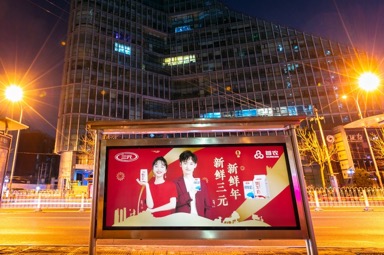
Beijing bus stop advertisements usually refer to lightbox advertisements set up in bus stop shelters. The common screen size is 3.5 meters wide and 1.5 meters high, and the lightbox is equipped with LED lighting, which can also clearly illuminate the advertising screen at night.
The advantages of this type of advertisement are:
Wide audience: set up in traffic arteries and bustling areas, covering passengers, passing pedestrians, and vehicles
Long dwell time: The average waiting time for the bus is 3-5 minutes, which facilitates in-depth reading of advertising information
Outstanding nighttime effect: Lightbox lighting makes advertisements particularly eye-catching in the dark
Adjacent to sales terminals: Many sites are located near commercial districts and communities, directly reaching consumer decision-makers
2、 Core Forms and Price System (Reference 2026)
The price of bus stop advertisements in Beijing is mainly determined by the regional level - the more bustling the location, the more expensive the price. According to the latest market data, the core form prices are as follows:
Bus shelter lightbox (3.5m × 1.5m)
Core areas (Guomao, Xidan, Financial Street, etc.): The published price is about 34000 yuan/month, and the discounted price is about 9800 yuan/month
General area: Prices decrease, remote areas can be as low as thousands of yuan
Coverage: Mainly in the core area within the Fourth Ring Road
Solar powered station sign (1.86m × 0.56m)
Publication fee: 650 yuan/block · month
Distribution: There are 152 streets in the city, totaling 1798
Features: Green and environmentally friendly, with built-in lighting
Box type station sign (1.86m × 0.6m)
Publication fee: 600 yuan/block · month
Distribution: 12 streets in the city, totaling 523
Station lightbox
Publication fee: 2000 yuan/block · month (public service advertising price)
Distribution: 9 bus stops, 156 light boxes
Features: Located at the bus terminal, with a concentrated flow of people
Attention: The above is the media release fee, and the actual placement requires an additional production and installation fee (approximately 2000-50000 yuan/piece) and taxes. The more placements and longer cycles, the greater the discount.

3、 Step by Step: Complete the advertising placement at bus stops in five steps
Step 1: Clarify goals and budget
First, ask yourself three questions:
Who is my target audience? Are they the business elites of Financial Street, the young consumers of Xidan, or the family members of the community?
What is my advertising budget? 100000, 300000, or 500000? This determines how many sites you can cover and how long you can invest.
What is my marketing objective? Brand exposure, new product launch, or store traffic?
Suggestion: For beginners who are launching for the first time, it is recommended to choose 3-5 core sites to launch for 3 months, verify the effectiveness, and then gradually scale up.
Step 2: Scientific screening of sites
Beijing bus stop advertisements follow the principle of "the more bustling the location, the more expensive the price". Different regions are suitable for different targets:
Guomao/CBD area
Crowd portrait: white-collar workers, business people
Suitable brands: finance, automotive, high-end services, workplace consumption
Xidan/Wangfujing
Crowd portrait: young consumers, tourists
Suitable brands: fashion apparel, beauty, catering, entertainment
Financial Street
Crowd portrait: financial professionals, corporate executives
Suitable brands: private banking, high-end wealth management, business gifts
Surrounding communities (such as Huilongguan and Tiantongyuan)
Crowd portrait: Family group
Suitable brands: education and training, home decoration, local living services
Suggestion: Go to the target site on site to observe and personally feel the peak period and characteristics of the crowd.
Step 3: Determine the form and combination of advertising placement
Choose the appropriate advertising mix based on budget and goals:
Budget of 100000 to 300000 yuan
Recommendation: Station advertising+3-5 core station waiting shelters
Features: controllable cost, wide coverage
Budget of 300000 to 600000 yuan
Recommendation: 5-10 core station waiting shelters+station signage supplement
Characteristic: Forming regional momentum
Budget of 600000 to 1 million yuan
Recommendation: Combination of bus shelters and station signs for the entire core line
Characteristic: Significant scale effect
Step 4: Creative Design - Customize Bus Stop
The viewing scenario for bus stop advertisements is' waiting ', which means that the audience has relatively sufficient time to read, but the advertisement still needs to quickly capture attention.
The Three Second Rule: Three things must be conveyed within 3 seconds - the brand logo (to be large), the core message (to be short), and the action instructions (to be clear).
Design points:
The screen is concise, with one image, one text, and one action
Strong color contrast and clear recognition even at night
The font is large enough to be read from a distance
Consider adding QR codes to facilitate interactive scanning
Step 5: Select a service provider and execute the advertising campaign
The advertising resources of Beijing bus stops are mainly operated and managed by official institutions such as Beijing Bus Media Co., Ltd. (Beibu Media). Ordinary advertisers usually advertise through professional agencies.
The benefits of finding a professional agent:
Obtain real resource prices and schedules
Obtain experience based site combination recommendations
Enjoy discounts on large-scale procurement
Obtain full process services from design review to publication monitoring and broadcasting
Tianci Media is a professional public transportation advertising platform that has been deeply involved in Beijing's public transportation media for many years. It has a database of bus stops covering the whole city and rich advertising experience. It can quickly output a list of matching bus stops and cost-effective analysis reports based on your goals.
Execution process:
Determine the placement location and cycle
Advertiser Design Screen
Screen submission review (to ensure compliance with advertising laws)
Produce the previous issue
Obtain the monitoring report of the previous publication
Attention: The entire process needs to be reserved for at least one week.
4、 The 4 easiest pitfalls for beginners to step into
Pit 1: Only looking at the price, not the value of the site
The cheapest station may lead to the suburbs, with sparse daily passenger flow. Stations passing through the core business district may have higher unit prices, but the cost per thousand people may be lower.
Avoiding pitfalls: Calculate CPM (cost per thousand people), where the monthly fee for a single point is divided by (average daily flow x 30 ÷ 1000)=CPM, and the lower the cost, the more cost-effective it is.
Pit 2: Neglecting production and installation costs
The media release fee on the quotation usually does not include production and installation fees. The production cost of a bus shelter lightbox may account for 20% -30% of the budget.
Avoiding pitfalls: Confirm the "all inclusive price" before signing the contract - whether it includes media fees, production fees, initial installation fees, post replacement fees, and taxes.
Pit 3: The advertising cycle is too short
I'll try the effect for a month first. "- It's difficult to see results within a month. Bus stop advertisements need to accumulate frequency to form memory.
Avoiding pitfalls: Invest for at least 3 months. If the budget is limited, the number of locations can be reduced to lengthen the cycle, rather than shortening it.
Pit Four: Neglecting Compliance
The core functional areas of the capital, such as Xicheng District, have strict planning restrictions on outdoor advertising, and must be placed through legitimate channels to confirm the legality of the location.
Avoiding pitfalls: Choose a reputable agency to ensure that the content of the images complies with advertising laws and urban management regulations.
5、 Conclusion: Let brands "wait" for the right people on the streets of Beijing
Beijing bus stop advertising is essentially a series of "waiting encounters" between the target audience and the city's transportation nodes.
For beginners, the key to success lies in: clear goals, scientific selection of points, creative adaptation, and professional execution. Don't be too greedy for completeness, start with small-scale testing, verify the effectiveness, and then gradually scale up.
Beijing has over 20 million permanent residents, with nearly 8 million people waiting at bus stops every day. By choosing the right location, your brand can truly enter the hearts of consumers during these waiting moments.
Tianci Media is a professional public transportation advertising platform that provides one-stop professional services from demand analysis, station evaluation, creative execution, and effect tracking. Consult now for your exclusive Beijing bus stop advertising placement plan!