How to place outdoor billboards in Beijing? Understanding the core value of commercial districts, transportation, and communities in one article
2026-03-11Tianci MediaViews:151
Highlights
How to place outdoor billboards in Beijing? This article provides a detailed explanation of the value of core locations such as Guomao, Yonghe Temple, and Chang'an Avenue, from budget planning and approval processes to creative design, with a real case study of Yonghe Temple's famous brand worth 2 million yuan per year attached. Tianci Media is a professional outdoor advertising placement company that helps you efficiently advertise in Beijing and avoid pitfalls!
In Beijing, a super first tier city with over 21 million permanent residents and an average daily floating population of over 10 million, outdoor billboards have never been simply "information displays", but a strategic competition for consumer attention, brand awareness, and urban space.
Imagine your brand image standing on the glass curtain wall of Guomao CBD, shining in the dazzling lights of Wangfujing Pedestrian Street, or appearing on the anti-aircraft billboard of East Third Ring Road with the continuous flow of traffic. This is not only an exposure, but also a declaration of brand strength, market ambition, and urban style.
For brand owners who are new to outdoor billboards in Beijing, they often feel at a loss when faced with complex approval processes, significant price differences, and strict compliance requirements. This article will systematically review all aspects of outdoor billboard placement in Beijing, from value recognition to practical steps, providing a complete introductory guide.
1、 Why are outdoor billboards worth paying attention to in Beijing?
Before starting the launch, it is necessary to understand the uniqueness of the Beijing market.
1. Highly standardized management environment
Beijing has the strictest management regulations for outdoor advertising in the country. There are clear prohibitions or restrictions on the installation of facilities in major areas, such as along Chang'an Avenue and around important political and cultural venues. The areas around Tiananmen Square, Zhongnanhai, Chang'an Avenue and its extension (from the east end of Guomao Bridge to the west end of Xinxing Bridge) are clearly prohibited from setting up commercial outdoor advertising facilities. This means that compliance is the first prerequisite, and it is not something that can be freely invested with money.
2. Diversified scenarios and value stratification
The value of outdoor advertising scenes in Beijing varies greatly:
Core business districts (such as Guomao, Sanlitun, Xidan): top value, strong audience consumption power, and the best brand display effect.
Main transportation arteries (such as ring roads and airport highways): covering a large number of commuters, suitable for establishing broad recognition of mass brands.
Landmark buildings (such as the Yonghe Palace Building): With their unique geographical location and cultural influence, they are expensive but reach a high quality audience.
3. High cost and strict requirements for effectiveness
Beijing's outdoor advertising media resources are scarce and the rent is high. This requires every investment to undergo precise calculations, with extremely high requirements for return on investment. Blind advertising can easily lead to huge waste.

2、 Core Points and Price Reference for Outdoor Billboards in Beijing
1. Landmark outdoor brand: a window of image where every inch of land is valuable
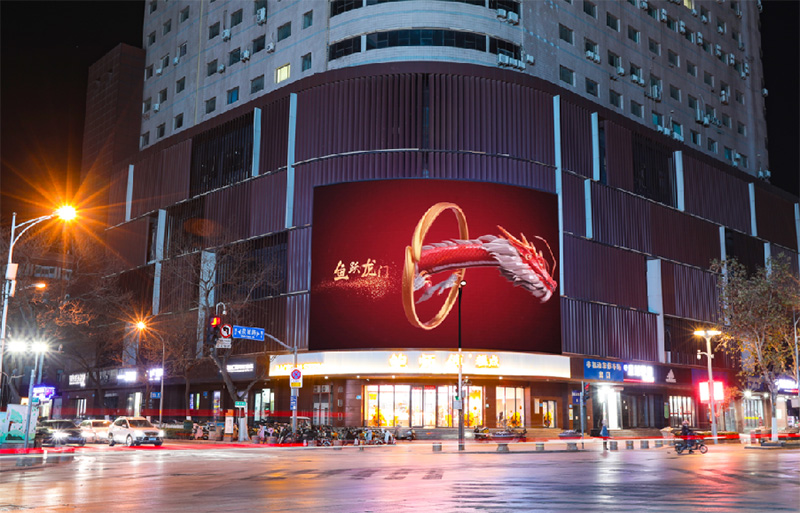
Yonghe Palace Outdoor Billboard: Located on the south side of the eastern section of the North Second Ring Road in Dongcheng District, Beijing, at the intersection of the North Second Ring Road and the airport expressway, the wall lightbox billboard is prominently positioned with a long visible distance. The estimated daily pedestrian flow is 1.2 million, and the daily vehicle flow is 600000 vehicles. The location attributes cover multiple scenarios such as commercial areas, urban main roads, and tourist areas. The media specifications are 6 meters wide by 10 meters high (single-sided), with a publication price of up to 2 million yuan per year.
This case illustrates that outdoor billboards in the core areas of Beijing can cost millions of dollars per year, making them a must-have for large brands to establish a high-end image.
2. External wall advertising in core business districts: a dynamic market priced by square meters
The fees for advertising spaces on the exterior walls of Beijing skyscrapers are usually quoted in the form of "yuan/square meter/month" or overall monthly/annual packages, with a wide range of fees ranging from tens of thousands to millions of yuan per month.
Core business districts (CBD, Financial Street, etc.): Static advertising space costs about 200-600 yuan/square meter/month; Large LED screens may cost 800-1500 yuan/square meter/month, with overall monthly package fees often ranging from 100000 to 500000 yuan or more. For example, the monthly rent for the exterior walls of high-quality buildings in the CBD area can reach 300-800 yuan per square meter or higher.
Secondary commercial districts (Wangjing, Shangdi, etc.): Static advertising space costs about 100-300 yuan/square meter/month, with overall monthly packages mostly ranging from 50000 to 200000 yuan.
Surrounding transportation hubs (near airports and train stations): Due to the large floating population, prices are close to the core business district, but specific approval requirements need to be considered.
3. Specifications and audience value of various outdoor brands
Outdoor big brand advertisements in Beijing cover the core areas of the city, including bustling commercial districts and transportation hubs such as Jishuitan Xinhua Department Store, Chongwenmen Soxiu Mall, Xizhimen North Exhibition Bridge, and Dongjialou Bridge on the third ring road. The size of the advertising space ranges from 6.5 meters by 4.5 meters to 20.6 meters by 16.2 meters, with a maximum foot traffic of 1.3 million people per day, accurately reaching diverse groups such as business elites, young consumers, and community families.
For example, the Baisheng lightbox advertisement at Fuxingmen on Chang'an Avenue showcases a high-end image and is suitable for government cooperation; Hujialou Gaohe Cui Lightbox focuses on CBD white-collar workers; The wall lightboxes of the Grand Canyon at the head of Wanfang Bridge cover the mainstream consumer population in the southern city.
3、 Seven step practical process for outdoor billboard placement in Beijing
Step 1: Clarify the advertising target and audience portrait
Before contacting any supplier, ask yourself three questions:
What is my core goal? (Enhancing brand awareness? Promoting specific products? Attracting traffic to offline stores?)
Where does my target customer live, work, and travel in Beijing?
What scenes do they often appear in?
A clear audience portrait is a lighthouse that guides all subsequent decisions.
Step 2: Understand the value hierarchy of core positions
Filter the matching areas based on the target:
Brand image display: Select core business district LED screens and high-end building lighting curtain walls.
Product promotion notice: Suitable for subway channel lightboxes, community lightboxes, and bus bodies.
Large scale event promotion: Consider airport expressway single column, urban landmark projection, etc.
Conduct on-site inspections of candidate locations, observe the quality of pedestrian and vehicular traffic at different time periods, and examine the surrounding environment and competitive products.
Step 3: Scientifically formulate the budget
Budget composition: It not only includes media rental, but also needs to reserve design and production fees, installation and construction fees, approval fees, maintenance fees, and possible taxes and fees.
Taking outdoor signage in a building as an example, the total cost mainly consists of design fees, material fees, production and installation fees, approval fees, and maintenance fees
Basic type (such as acrylic luminous characters): The unit price is about 800-1500 yuan/square meter. A 10-20 square meter sign costs approximately 20000 to 50000 yuan.
Mid to high end models (such as stainless steel precision letters): The unit price is about 1500-3000 yuan/square meter, and the total cost is about 40000-80000 yuan for around 20 square meters.
High end customized type (such as LED display screen): Large LED screens can cost thousands to tens of thousands of yuan per square meter, and the overall project may exceed 200000 yuan.
Suggest reserving 10% -15% of emergency funds in the total budget to cope with uncertain factors such as approval adjustments and material price fluctuations.
Step 4: Complete the crucial approval process
This is the most complex part of outdoor billboard placement in Beijing. According to the "Regulations on the Management of Outdoor Advertising Facilities, Plaques, Signs, and Slogans in Beijing", the installation of outdoor advertising facilities must comply with the planning conditions and requirements stipulated in the outdoor advertising facility installation plan. If the plan for setting up outdoor advertising facilities in the neighborhood has not been formulated, outdoor advertising facilities shall not be set up.
Set up program:
Search for the planning conditions and requirements for setting up outdoor advertising facilities in the "Comprehensive Service Information System for Outdoor Advertising Facilities, Plaque Signs, and Slogan Promotional Materials Management".
Obtain the consent of the carrier owner or manager.
Develop a plan for setting up outdoor advertising facilities, upload it to the comprehensive service information system, and make it public to the society.
List of materials to be prepared:
Plan Information Form (including setting plan documents, property rights or management consent forms, safety assessment reports for attached outdoor advertising facilities, building floor plans, building elevations, building engineering planning permits, business licenses, etc.)
Facility Information Table (including daytime and nighttime renderings)
The approval cycle is usually 15-20 working days, and it is necessary to plan 1-2 months in advance.
Step 5: Creative Design - Tailored for the Beijing Market
In the creative design of outdoor billboards in Beijing, several core principles need to be followed:
Visual impact: Capture attention in a brief 3-5 second contact. Large font, strong contrast, minimalist information.
Localization of information: Beijing elements or dialects can be appropriately integrated to increase familiarity and resonance.
Strong persuasive language: Clearly tell the audience what to do next, such as "scan the code to collect" or "navigate to".
In the fast-moving streets of Beijing, complex designs are equivalent to ineffective designs. Meanwhile, content that is too westernized or unrelated to local culture is difficult to resonate with.
Step 6: Select reliable suppliers and supervise their implementation
When selecting a supplier, one should consider whether they have successful cases, are familiar with the approval processes in various districts of Beijing, and can provide complete installation and maintenance services.
In terms of execution supervision, strict supervision is carried out on the quality of painting, installation safety, and release time to ensure full consistency with the contract agreement. If the damaged image is not repaired in a timely manner and the lights are not on, it will greatly reduce the huge investment.
Step 7: Continuously monitor the effectiveness and optimize adjustments
Process monitoring: Regularly check the integrity of advertising images to prevent them from being obstructed or damaged.
Effect tracking: Using a combination of online and offline methods (such as specific QR codes, activity codes, and public opinion monitoring) to evaluate actual effects and provide data support for subsequent optimization. Outdoor advertising should be the tipping point or amplifier of the entire marketing campaign, and must simultaneously plan social media interaction, online search reception, offline activity drainage, and form an integrated communication loop.
4、 Common Misconceptions and Avoiding Pits Guide
Misconception 1: Blindly pursuing "landmarks" and ignoring the matching of cost-effectiveness and goals
Although the Guomao large screen is good, if your goal is to reach community households, its cost-effectiveness may be far inferior to the lightbox at the entrance of a chain supermarket. What is suitable is the best.
Misconception 2: Underestimating the complexity and time cost of approval can disrupt the marketing rhythm
Beijing has strict approval procedures, long cycles, and uncertainties. Do not wait until the marketing campaign is approaching before starting operations, be sure to reserve at least 1-2 months of approval buffer period. Special attention should be paid to the clear prohibition of setting up commercial outdoor advertising facilities in areas such as Tiananmen Square, along Chang'an Avenue, and around Zhongnanhai.
Misconception 3: Only focusing on the cost before advertising, neglecting the maintenance during advertising and the evaluation after advertising
Failure to repair damaged images in a timely manner, dim lighting, and lack of tracking of data effects can all greatly reduce the huge investment. Refined operation is the lifeline to ensure effectiveness.
Misconception 4: Ignoring "hidden costs"
In addition to direct rent, budget for production and installation fees, maintenance and electricity fees, government approval and management fees, etc. are also required. Especially LED screens require regular maintenance and bear higher electricity costs. It is recommended to allocate 10% -15% of the total budget for emergency expenses.
Misconception 5: Collaborating with Unprofessional Suppliers
Choosing an advertising company with rich case studies and familiarity with local approval processes in Beijing can provide one-stop services from design, approval to installation. Although the total price may be slightly higher, it can save a lot of time and hidden costs.
5、 Conclusion: Make outdoor billboards in Beijing the engine of brand growth
The placement of outdoor billboards in Beijing is a systematic project from strategy to execution, from compliance to creativity. It is not like online advertising that can be adjusted at any time, nor is it like social media where low-cost trial and error is possible. Instead, it is a brand strategic investment that requires precise calculation and strict execution.
The key to success lies in scientific planning: clear goals, selected locations, compliance first, creative adaptation, and professional execution. For beginners, it is recommended to start by understanding regulations and gradually delve into location research and budget planning.
Tianci Media is a professional outdoor advertising placement company that has been deeply involved in Beijing's outdoor billboard media for many years. It is familiar with the approval process in various districts and has rich location resources and placement experience. From requirement analysis, location evaluation to approval agency, creative execution, and effect tracking, we provide one-stop full process services to help you accurately showcase your brand on the skyline of Beijing with the most reasonable budget.