Full Analysis of Bus Advertising Quotations: The Latest Price and Budget Guide for 2026
2026-03-09Tianci MediaViews:137
Highlights
The pricing of bus advertisements is influenced by four factors: form, city, route, and cycle, ranging from a few hundred to tens of thousands of yuan. This article provides a detailed explanation of the price structure of vehicle body, interior, and station advertising, with real procurement cases from Bozhou, Lanzhou, Xinjiang, and other places attached to help you scientifically plan your budget. Tianci Media is a professional public transportation advertising platform that helps you efficiently advertise!
When brands need to go to the streets and integrate into the flowing scenery of the city, bus advertising is often a cost-effective choice. But for beginners, the most direct question is: how much does bus advertising cost? Why do some quote hundreds and some quote tens of thousands?
This article will help you thoroughly understand the pricing logic of public transportation advertising, from influencing factors, specific prices, real cases to avoidance guides.
1、 What determines the pricing of bus advertising?
There is no "uniform price" for bus advertising, and the price is the result of the combined effects of multiple variables. There are four main influencing factors:
1. Advertising format
Vehicle advertising has the highest cost because it covers a large area, has a strong visual impact, and can reach a wider audience. The advertisements inside the car and at the bus stop are relatively low. The advertising on the body of a bus can cost thousands to tens of thousands of yuan, while the advertising inside the bus may only cost a few hundred to a few thousand yuan.
2. City level and region
The core areas of first tier cities generally have higher advertising costs; Remote areas or suburban routes are relatively affordable. The monthly cost of double decker buses on Beijing's Fourth Ring Road ranges from 25000 to 100000 yuan, while the same amount of buses may only cost half in second - and third tier cities.
3. Line type
Commuting routes that pass through core business districts and main roads have high passenger flow and stable crowds, and their prices are much higher than suburban or tourist routes.
4. Placement cycle
Long term advertising (such as quarterly or annual) can receive discounts and reduce daily costs; Short term advertising (such as one week) has a higher unit price.
2、 Reference for mainstream forms of quotation
1. Vehicle advertising
Vehicle advertising is the core form of bus advertising, covering both sides of the vehicle and the rear. The quotation varies significantly depending on the city and route.
Core route in first tier cities: Beijing Fourth Ring Road 400 double decker bus, with a monthly cost of approximately 25000 to 100000 yuan
Ordinary routes in second and third tier cities: monthly costs range from thousands to tens of thousands of yuan
It should be noted that the above prices usually only include media release fees and do not include image production and installation fees. According to the procurement announcement of Bozhou Bus in 2026, the unit price for the production and installation of bus body advertisements is 424.36 yuan per vehicle for the whole vehicle and 533.54 yuan per vehicle for the large three sides.
2. In car advertising
In car advertising includes various forms such as billboards, handles, and seat back advertisements. Passengers have ample time to read during long rides.
The daily cost of in car advertising is approximately between 300 yuan and 2000 yuan
Xinjiang Sports Lottery will purchase a mobile TV advertising project for buses in 2026, with a budget of 250000 yuan
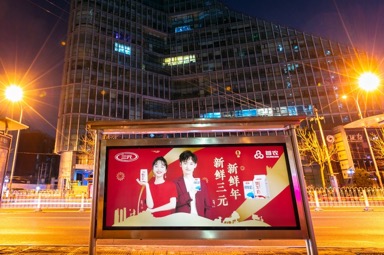
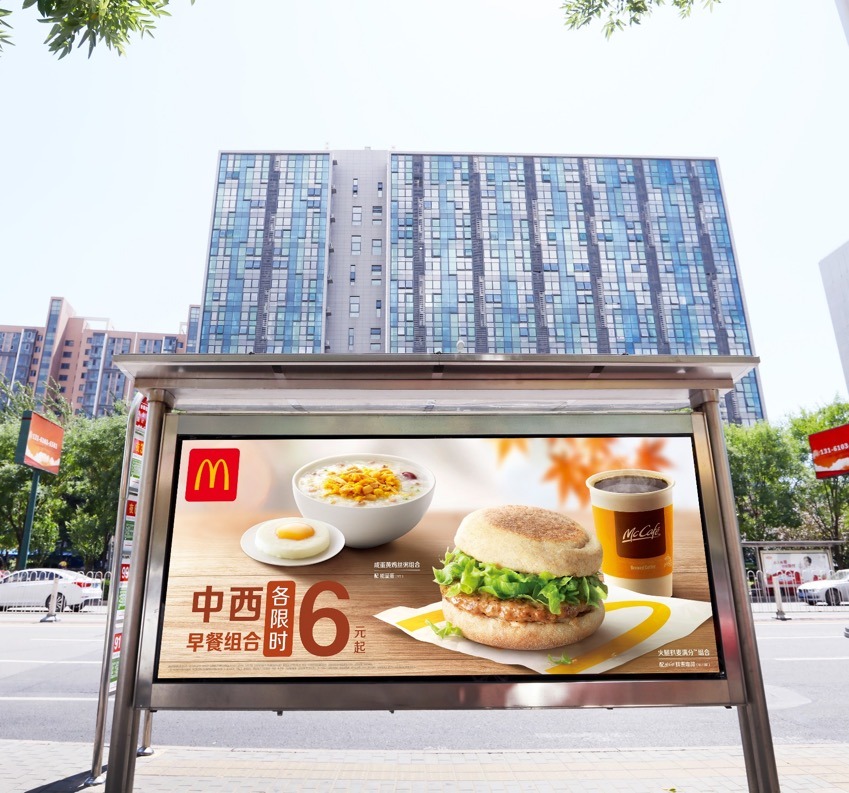
3. Bus stop signs/shelter advertisements
Bus stop advertisements are located at bus stops, covering the waiting crowd and offering relatively affordable prices.
The daily cost is approximately between 100 yuan and 1000 yuan
The bus shelter light box in Beijing Guomao CBD can cost up to 600000-1.2 million yuan per week, which is a top resource in the core business district. The price in ordinary areas is much lower
The advertising production cost for Bozhou bus stop is 10.3 yuan/square meter
3、 Real procurement case reference
Case 1: Urban and Rural Public Transportation in Lanzhou (2026)
Lanzhou Urban and Rural Public Transport Operation and Management Co., Ltd. offers advertising services for 115 city buses. The first year's bid price is 1.0925 million yuan, and the second year requires an increase of more than 5%. Converted, the annual rent for a bicycle starts at about 9500 yuan.
Case 2: Bozhou Public Transport (2026)
The winning bid for the production, installation, and maintenance project of bus advertisements in Bozhou urban area is 424.36 yuan per vehicle for the entire bus body, 533.54 yuan per vehicle for the third side, and 10.3 yuan per square meter for bus stop advertisements. This is the production and installation fee, excluding media release fees.
Case 3: Dongguan Public Transport (2026)
Dongguan Hongyun Media Co., Ltd.'s 2026-2027 public transportation vehicle and bus stop advertising production and service procurement project has a total budget of 3.83 million yuan. This includes comprehensive services such as advertising production, installation, and maintenance for a period of one year.
Case 4: Xinjiang Sports Lottery (2026)
The Xinjiang Sports Lottery 2026 Bus Mobile TV Advertising Promotion Project has a budget of 250000 yuan. This is mobile TV advertising, which is a form of in car advertising.
4、 What other costs are there besides media fees?
Total cost=media publishing fee+production and installation fee+creative design fee+maintenance fee+taxes and fees
Media publishing fees: accounting for 60% -70%, which is the core cost
Production and installation costs: accounting for 10% -20%, as shown in the Bozhou case, the body production cost is about 400-500 yuan/vehicle
Creative design fee: 5% -10%, professional design quoted according to the project
Maintenance and data monitoring fees: 5% -10%
Taxes and management fees: approximately 5%
Newcomers who are launching for the first time are most likely to overlook the production and installation fees. When signing the contract, it is important to ask: Does the quotation include tax? Does it include production and installation? Who is responsible for the damage to the screen?
5、 Common Misconceptions and Avoiding Pits Guide
Misconception 1: Only focus on price, not the value of the route
The cheapest routes often lead to the suburbs, with sparse daily passenger flow. The route passing through the core business district may have a high unit price, but the "effective target audience reach cost" may be lower.
Misconception 2: The advertising cycle is too short
Bus advertising requires time to accumulate effects. After 1-2 weeks of deployment, the vehicles have not yet covered the entire route, making it difficult to form effective awareness. It is recommended to advertise for at least 3 months.
Misconception 3: Creativity does not consider mobile viewing
Vehicle advertising is a 'three second art' - complex copy and details cannot be seen clearly during rapid movement. We must adhere to the minimalist principle of "one image, one article, one logo".
Misconception 4: Failure to conduct advertising monitoring
It is necessary to require the agency to provide a "publication monitoring report" (including vehicle number, operating status, and advertising image photos/videos) to ensure that the advertisement is published normally according to the contract.
Misconception 5: Finding unqualified intermediaries
Bus advertising resources are mainly managed by official operators or legitimate agents. It is recommended to contact professional public transportation advertising platforms like Tianci Media for inquiries and plan solutions. They have access to the latest resource prices and schedules, and can help you plan cost-effective route combinations, as well as handle the entire process from design review to publication monitoring.
6、 Conclusion: How to scientifically plan the budget for public transportation advertising?
Bus advertising prices range from a few hundred yuan to tens of thousands of yuan, and the key is to choose the appropriate city, route, and form based on one's own goals, budget, and audience.
Three steps for budget planning:
Clear goal: city wide exposure or regional deep cultivation? Brand building or promotion driven traffic?
Route selection: Select the passing area based on the target audience and verify the route direction with a map
Combination advertising: With sufficient budget, a combination of "full body+interior+bus shelter" can be used, while with limited budget, 2-3 core routes can be focused on for "saturation attack"
Tianci Media is a professional public transportation advertising platform that has access to public transportation media resources and rich advertising experience in major cities across the country. From demand analysis and route evaluation to price negotiation and creative execution, we provide one-stop full process services to help you achieve efficient public transportation advertising placement with a reasonable budget.