Outdoor Single Column Advertising: A Comprehensive Guide to Definition, Advantages, and Placement
2026-01-30Tianci MediaViews:125
Highlights
This article is the ultimate guide to outdoor single column advertising for beginners. Provide a detailed analysis of its core advantages, the complete steps from planning to deployment, and reveal common misconceptions. Through examples such as the Beijing Wukesong Light Show, we can help you understand how to efficiently utilize resources such as single column advertising in Beijing to enhance brand influence. Read now and develop your outdoor advertising strategy!
When you drive on highways, onto city main roads, or enter bustling commercial districts, those towering, independent, and stunning giant billboards are outdoor single column advertisements. It is known as the "heavyweight" in outdoor advertising media, with its undeniable visual impact and long-term, stable exposure ability, becoming a powerful tool for many brands to establish high-end images and occupy regional markets.
But for beginners, single column advertising seems to carry a mysterious veil: is it expensive? How to measure the effect? How to choose a location? This article will start from scratch and systematically dissect all aspects of outdoor single column advertising to help you make informed marketing decisions.

Chapter 1: Understanding "Outdoor Single Column Advertising" - Urban Landmarks and Brand Lighthouse
1.1 What is outdoor single column advertising?
Outdoor single column advertising usually refers to large billboards supported by a single or multiple steel columns and erected on the ground. Its height is generally between 15 meters and 40 meters, and the advertising screen area is huge (commonly such as 18m × 6m), displayed on both or three sides, with a very long visible distance. It is different from wall advertisements attached to building walls, as it is an independent media that exists independently. Therefore, it has flexible site selection and strategic value, especially in transportation hubs, urban entrances and exits, core commercial districts, and other areas.
1.2 Core Advantages: Why do brands choose it?
Super visual dominance: The huge screen size and elevated position make it stand out in complex environmental information and forcefully enter the audience's field of vision.
24/7 exposure: Regardless of weather conditions, advertisements are always online, providing continuous brand reminders and image displays.
Locking in high-value traffic: usually located on highways, airport roads, and city main roads, it can effectively cover high consumption mobile populations such as drivers and business people.
Establishing brand authority and trust: The huge physical media itself can convey the strength and scale of the brand, quickly enhancing the brand's visibility and high-end sense in specific regions.
Long term media, cost dilution: Although the initial investment is high, its cost per thousand people (CPM) is often competitive based on a release cycle of several months or even a year.
Chapter 2: Four Steps to Practical Operations - From Planning to Successful Delivery
Step 1: Clarify Goals and Strategies (Why&What)
Before searching for a location, ask yourself:
Brand Goal: Is it a new product launch explosion or a mature brand consolidating its image? Is it to inform about promotional activities or to increase market share in specific regions?
Audience Profile: Which routes in the city do your target customers frequently appear on? Is it a commuting main road or a leisure shopping district?
Information design: A single column is a medium for "long-distance reading". The screen must be extremely concise: brand logo, core slogan/product, contact phone number or QR code (large enough), all three are indispensable. Design should have strong contrast and convey core information within 3 seconds.
2.2 Step 2: Scientific Site Selection - Location determines everything (Where)
Site selection is the lifeline of the success or failure of single column advertising.
Traffic and Quality: It is not only important to consider the traffic/pedestrian flow, but also to analyze the composition of traffic. For example, the location selection of single column advertisements in Beijing will focus on the roads leading to airports, high-tech zones, and large exhibition centers (such as the National Convention Center).
View and Stay: Choose a location with a wide and unobstructed view, and try to choose areas where vehicles naturally slow down, such as waiting at red lights, speed bumps at highway exits, and intersection ramps, to increase the time the advertisement is read.
Competitors and Environment: Evaluate the surrounding advertising environment to avoid being overwhelmed by other billboards. At the same time, consider the tone of the surrounding buildings to ensure consistency with the brand image.
Policy and Compliance: It is essential to confirm that the advertising space procedures are complete and comply with local urban management and outdoor advertising placement plans. Cooperating with operators such as Tianci Media who have rich media resources and compliance experience can effectively avoid risks.
Step 3: Creativity and Production - Let the Picture Speak (How)
Material selection: commonly used printing fabrics, mesh fabrics (with strong wind resistance), and emerging digital UV printing to ensure that the image does not fade or deform under long-term sun and rain exposure.
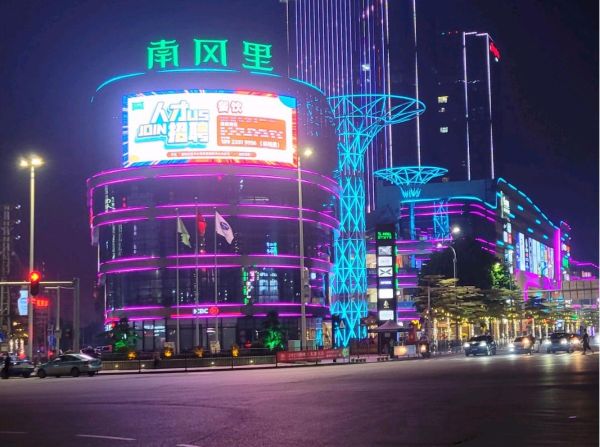
Lighting configuration: Night effect is crucial. High quality LED external lights or internal light sources can ensure that advertisements are as dazzling as the Beijing Wukesong light show at night, doubling the exposure time.
Craftsmanship and Installation: A professional installation team can ensure structural safety and cope with adverse weather conditions such as strong winds. A tight and smooth image is the foundation of aesthetics.
Step 4: Effect Monitoring and Optimization (Measurement)
The effectiveness of outdoor advertising is not immeasurable:
Preliminary data estimation: Request professional traffic monitoring reports from the media (such as daily traffic flow data and pedestrian flow data).
Technical support: Combined with geofencing technology, online advertising re marketing is carried out for mobile phone users passing through specific areas of billboards, tracking online conversion behavior.
Exclusive design: Place large QR codes, dedicated promotional codes, or unique contact numbers on the advertising screen to directly track offline traffic flow effects.
Brand research: Conduct brand awareness research in the target area before and after advertising to quantify the increase in awareness brought by advertising.
Chapter 3: Advanced Perspectives and Common Misconceptions Reminders
3.1 Integrated marketing: A single pillar is not an isolated island
Consider single column advertising as the "visual center" of integrated marketing campaigns. It can be linked with online activities, social media, and offline activities. For example, pre announcing activities on single column advertisements and guiding them towards social media interaction; Or when holding offline events, use surrounding single pillars for atmosphere preheating and diversion. This "outdoor+" model, just like the integration of column advertising at Beijing Subway A++level stations with digital media and online topics within the subway, can generate a synergistic amplification effect.
3.2 Three major misconceptions that beginners must avoid
Misconception 1: Only seeking affordability, ignoring location. The remote and low traffic low price point, coupled with its extremely low exposure efficiency, means higher actual costs. Better short-term investment in prime locations than long-term idle in remote areas.
Misconception 2: Information overload and complex design. Treat the single column as a product manual, filled with text and images. As a result, nothing can be seen clearly from a distance, and advertising fees are greatly discounted. Remember 'less is more'.
Misconception 3: Once invested, there is a lack of evaluation. Without any effect tracking or strategy adjustment after the launch, it is impossible to accumulate effective experience for the next launch, resulting in marketing decisions always based on "feelings" rather than "data".
Conclusion
Outdoor single column advertising is a strategic brand investment. It is not simply "renting a brand", but a systematic engineering that covers strategic positioning, scientific site selection, creative design, safety production, and effect evaluation. For enterprises that hope to establish brand landmarks at key urban nodes, efficiently reach high-value mobile populations, and demonstrate brand strength, it is a necessary task to master.
A successful single column advertising campaign begins with a clear strategy, becomes a precise site selection, and finally achieves outstanding creativity and scientific evaluation. In the era of information explosion, a brand lighthouse occupying the visual high ground of a city often delivers the most powerful blow to open consumers' hearts with its trust and authority. Now, it's time to re-examine and plan your outdoor advertising strategy.