Which enterprises are suitable for elevator advertising? A precise matching guide based on scenarios and targets
2026-01-23Tianci MediaViews:94
Highlights
Do you want to know which companies elevator advertising is suitable for? This article deeply analyzes its core scenario value, providing a complete model for evaluating industry characteristics, marketing goals, and budget dimensions, and attaching a self-assessment checklist for enterprises. Accurate judgment to avoid ineffective advertising. Immediately evaluate your company's compatibility!
In the case of limited marketing budget, choosing advertising media that is "like-minded" with one's own business is the first step to success. Elevator advertising, a medium that permeates our daily lives, has attracted the attention of many businesses due to its high exposure, mandatory reach, and community attributes. But a core question also arises: which companies are suitable for elevator advertising? Can all enterprises get a share of the pie, or is it only for specific players?
A simple 'yes' or' no 'answer is meaningless. True professional decision-making stems from a deep analysis of the fit between the essence of media and the needs of the enterprise. This article will go beyond the general discussion and build a clear evaluation framework for you, helping you scientifically judge whether elevator advertising has opened an efficient marketing door for your enterprise from three dimensions: industry characteristics, marketing goals, and resource capabilities.
Step 1: Understand the "scene genes" of elevator advertising
Before discussing adaptability, it is necessary to understand the characteristics of the "marketing soil" of elevator advertising, just like understanding the soil.
1.1 Core advantage: "Three Highs" value in enclosed spaces
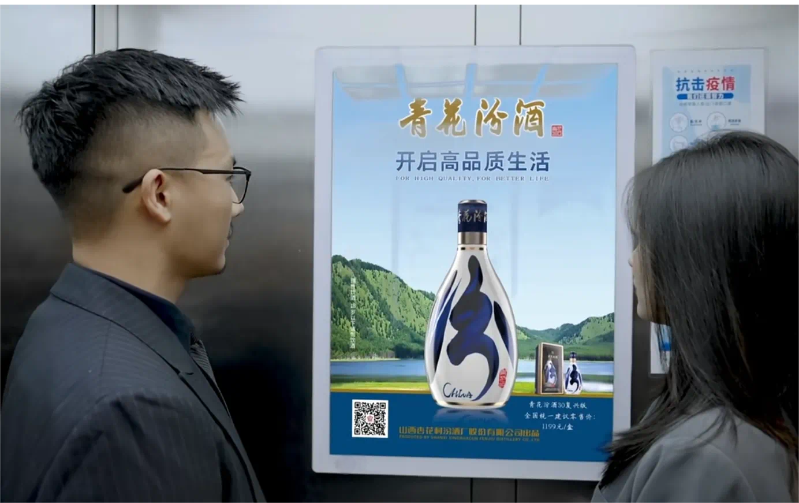
High forced reach: In the narrow, enclosed, and briefly boring space of elevators, advertising is the only visual landing point, and exposure is almost unavoidable.
High frequency repetition: Community residents or office building employees ride regularly at least twice a day, ensuring that advertising information can be repeatedly remembered and form a brand imprint.
High ground reasoning and targeted audience: Advertisements are directly embedded in specific communities or buildings, which can accurately reach households and individuals in specific geographic locations, consumption levels, and even specific stages of life.
1.2 Key Features: Localization, Community oriented, and Instant
Elevator advertising is not a loudspeaker aimed at the whole country, but a loudspeaker that goes deep into the streets and alleys. The information it conveys has a strong sense of proximity and liveliness. It excels at influencing consumers' "last mile" consumption decisions.
By understanding these points, we have the cornerstone for judging adaptability. The higher the match between these genes and the enterprise, the greater the power of elevator advertising.
Step 2: Adaptability Assessment - Which category does your enterprise belong to?
We can divide adaptation enterprises into three types: highly adaptable, strategy adaptable, and cautious trial and error oriented.
2.1 Highly adaptable: perfect fit between core business and scenario
The products or services of such enterprises are naturally the "surrounding needs" of community residents or office building populations, and elevator advertising is an inevitable choice for their marketing channels.
Local life service category:
Educational institutions: children's training, K12 tutoring, interest classes. Directly reaching parents with children, the decision-making scenario is highly matched.
Home decoration: cleaning, nanny, decoration, maintenance. When there is a demand in the family, the advertisement of "looking up but not looking down" can be immediately remembered.
Medical beauty dentistry: dental clinics, light medical beauty institutions. Relying on local customer sources requires establishing long-term trust, and the elevator has a strong sense of community endorsement.
High frequency fast-moving consumer goods and household consumption:
Community retail: fresh supermarkets, community group buying, fruit stores. Advertising directly drives the instant consumption of "buying on the way after work".
Food and beverage: New products such as milk, yogurt, and snacks. Drive brand selection and repeat purchases in household consumption scenarios through high-frequency exposure.
Real estate and financial services:
Surrounding buildings and intermediaries: new buildings and second-hand housing intermediaries. Accurately intercept residents in the same area with potential housing and rental needs.
Community banking and insurance: credit cards, mortgages, property insurance. Penetrating financial services in a highly trusted community environment.
2.2 Strategy adaptation type: Need to combine clear goals and creativity
The business of such enterprises is not naturally localized, but specific marketing goals can be achieved through clear strategies and elevator advertising.
Internet platform and APP (localization and innovation):
Local lifestyle apps such as Meituan and Ele.me conduct saturation attacks on competitors in specific areas, resulting in significant new user acquisition effects.
E-commerce platforms: JD.com and Tmall supermarkets promote "one hour delivery" services to strengthen local warehousing and instant delivery awareness.
Tool based apps: fitness and reading apps, targeted at specific groups in high-end communities or office buildings for precise promotion.
Durable consumer goods and B2B services (precise exposure and investment attraction):
Automobile brand: New models are launched, showcasing brand image and cultivating potential car owners in high-end communities.
Building materials and home furnishings: high-end bathroom and cabinet brands engage in interception marketing in new communities during the delivery phase.
Enterprise services: office leasing, cloud services, legal consultation, reaching business decision-makers in the elevators of commercial office buildings.
Brand builders (shaping image for specific audiences):
High end consumer goods: red wine, high-end kitchenware, shaping the brand image of "the choice of neighborhood elites" by entering high-end communities.
Emerging domestic brands: By placing advertisements in popular office buildings where young white-collar workers gather, quickly establish trend awareness.
2.3 Cautious trial type: requires rigorous argumentation and innovative strategies
There is a certain distance between these types of enterprises and the conventional logic of elevator scenarios, and unless there is a very innovative strategy, the input-output ratio may be poor.
Pure online products without regional attributes, such as nationwide online education (wireless download) and certain niche software. It is difficult to link online traffic to specific communities.
The target audience is extremely broad for popular fast-moving consumer goods such as bottled water and chewing gum. Although everyone uses it, the coverage cost of elevator media may be higher than the marginal benefit it brings, which is more suitable for global coverage through television and the Internet.
High end luxury goods (partially): such as top tier watches and jewelry. Its marketing needs to create a sense of distance and dreams, and the "homely" atmosphere of community elevators may not match its tone, but it is an exception in top luxury elevators or five-star hotel elevators.
Step 3: How to make scientific decisions? ——A feasible self-test checklist
Theory is theory, and when it comes to your business, please use the following checklist for a quick self-test:
3.1 Core Three Questions
Scenario: Does my product/service generate demand from target customers near their "home" or "office"? Is this demand high-frequency or occasional?
Can I clearly describe what kind of community my core clients live in (housing prices, number of households, family structure) or what kind of office buildings they work in (industry, scale)? Can elevator advertisements accurately locate these places?
Question objective: Is my core goal for this advertising campaign "long-term brand penetration" or "immediate sales conversion"? Elevator advertising is better at the former, but the latter can also be achieved through clever design.
3.2 Adaptation Check between Creativity and Execution
Can my advertising message be clearly stated within 3 seconds? Elevator advertising is a 'second level art', and information must be extremely simplified.
Am I ready for a clear 'Call to Action' (CTA)? Convert exposure into action, such as QR codes, store addresses, and promotional phone numbers.
Does my advertising visual appeal meet the aesthetic standards of the community or office environment and not create any negative feedback?

Step 4: Common Misconceptions and "Persuasion" Signals
Before making a final decision, please be alert to these red light signals as they may indicate that your business is temporarily not suitable.
Misconception: Ignoring regional restrictions and hoping for nationwide prosperity.
Reality: Elevator advertising is a 'battlefield war', not a 'sports war'. It is necessary to conquer each region one by one. Pursuing the bigger picture will inevitably lead to scattered budgets and ineffective results.
Misconception: Pursuing "artistic expression" and neglecting information dissemination.
Reality: In elevators, consumers are not in the mood to appreciate overly abstract art. The first priority of advertising is to efficiently convey core information, and artistry serves the purpose of communication.
Misconception: Lack of offline capacity, wasting traffic.
Reality: If advertisements are directed offline, but the store experience is poor and the service cannot keep up; Or guided online, but the landing page experience is poor and customer service response is slow. So much exposure is always harmful to the brand.
Misconception: Expecting immediate results and lacking patience.
Reality: In addition to promotional advertising, the brand penetration effect of elevator advertising is "subtle and silent", usually requiring at least 1-3 months of continuous advertising to form stable cognition. Pursuing short-term explosive orders may lead to disappointment.
The 'discourage' signal: Your core customers are not going to elevators with commercial advertisements at all. This is a fundamental issue. For example, your clients may be factory workers, field farmers, or specific niche groups who do not have commercial elevator advertisements in their daily lives and work scenarios.
Conclusion: Matching is the starting point for efficiency and return
Which enterprises are suitable for elevator advertising? The answer is not in the media itself, but in the resonance frequency between your company's genes and the media scene. It is not a universal traffic artifact, but a precise communication tool tailored for enterprises whose business is rooted in the community, serving the local area, and committed to establishing high-frequency and trusting relationships with target customers.
The final decision should not be based on following the trend of 'I will do what others have done', but should stem from a calm self-examination: what is the essence of my business? Where do my clients live? What is the core task of my marketing this time? When these questions have clear answers, it becomes clear whether elevator advertising is a "weapon" or a "chicken rib" for you.
Please pick up this guide as a mirror and take a look at your business. If it matches, then the space between the elevators will become your most cost-effective golden marketing battlefield; If it doesn't match, save this budget and go find the soil that truly belongs to you.