In-Flight Advertising: The Captive Audience Advantage, Planning & Results Measurement
2026-08-15Tianci MediaViews:29
Highlights
Somewhere after the cabin doors close, something remarkable happens from a media perspective: several hundred people switch off their phones, strap into assigned seats, and remain there - awake, largely undistracted, and intermittently bored - for the next several hours. No other advertising environment offers this combination of forced presence, minimal competing stimuli, and prolonged dwell. Yet in-flight advertising remains one of the least understood channels, often bought as an afterthought to airport programs or skipped entirely. This guide explains the genuine advantages of advertising inside the aircraft cabin, analyzes who these passengers really are, lays out a practical planning approach, and details how to measure whether your in-flight campaign delivered.
1. The Advantages of Advertising Inside the Cabin
Absolute captivity. A passenger cannot scroll past, mute, or walk away from a seat-back screen, tray table, or headrest. Attention supply during cruise flight exceeds virtually every other medium - passengers actively seek stimulation to fill idle hours.
A media vacuum. With phones offline or restricted for much of the flight, the usual competition - social feeds, messaging, streaming - disappears. Your creative competes only against the window and a novel, a radically cleaner attention field than any terrestrial channel.
High-frequency, long-duration exposure. On a four-hour flight, a seat-back or overhead message accumulates hours of repeated visual contact. Frequency is built into the physics of the medium rather than purchased impression by impression.
An elite demographic. Air travelers over-index on income, education, and professional seniority; premium cabins concentrate high-net-worth individuals and corporate decision-makers. For luxury, finance, automotive, hospitality, and B2B brands, this is target-rich inventory.
A receptive psychological state. Leisure travelers are relaxed and open; business travelers are in a decision-oriented mindset between meetings. Both states outperform the defensive "ad-avoidance" mode audiences bring to interruptive media.
Destination intent. Passengers are, definitionally, going somewhere - creating natural relevance for hotels, ground transport, attractions, duty-free, insurance, and connectivity products pitched in the final hour of flight.
2. Analyzing the In-Flight Audience
Route structure is the primary targeting variable because route equals passenger profile:
Business routes (major financial and commercial centers, weekday morning/evening banks) deliver frequent corporate travelers: decision-makers for software, consulting, banking, and premium services. Front cabins and lounges concentrate this group further.
Long-haul leisure routes deliver affluent holidaymakers with long dwell times - ideal for destinations, resorts, luxury retail, and experiences.
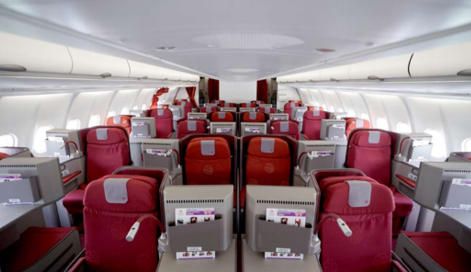
Premium and international cabins skew toward high-net-worth travelers with low price sensitivity, the hardest audience to reach at scale through any other channel.
Regional and family routes concentrate price-conscious and seasonal travelers, suited to value retail, entertainment, and local attractions.
Dwell time scales with distance, and so does message capacity: a 90-minute shuttle supports slogans and simple offers, while a 12-hour intercontinental flight can sustain detailed storytelling, catalog browsing, and multi-touch sequences across seat-back, tray, and magazine.
3. Planning an In-Flight Campaign
Set the objective before choosing formats. For awareness, prioritize cabin-wide surfaces - overhead bins, bulkheads, headrests - seen by everyone at boarding. For consideration, use tray tables, seat-pocket inserts, and in-flight magazines, which passengers examine at length. For response, use the Wi-Fi portal and duty-free pre-order, the only touchpoints with a live digital connection.
Design for proximity and tone. Cabin media are viewed at arm's length by a seated, stationary reader - closer than a billboard, calmer than a street. This permits denser information than outdoor norms allow, but the enclosed premium environment punishes loud, cluttered creative. Favor editorial-quality design that reads like native cabin content.
Sequence with the flight arc. Boarding and taxi favor bold brand statements when everyone is alert and scanning the cabin. Cruise favors deep engagement - video on seat-back entertainment, magazine features, detailed offers on tray tables. Descent and pre-landing favor action prompts: duty-free deadlines, destination services, and booking windows for ground transport and hotels.
Build the digital loop. The strongest in-flight programs pair physical placements with the Wi-Fi portal - captive audiences connecting mid-flight encounter a clickable, trackable ad layer. Vanity URLs and promo codes printed on physical formats capture response that occurs after landing, when phones return.
Navigate airline approval early. Creative must pass airline content and safety review, meet aircraft-specific production specs, and schedule around maintenance windows. Lead times of four to eight weeks are normal; international carriers may require longer. Budget for both media and specialized production.
Commit to adequate duration. A single aircraft on a single route may reach only a few thousand passengers weekly. Meaningful frequency requires multi-week or seasonal commitments, often across a small fleet or route family rather than one tail number.
4. Measuring In-Flight Campaign Results
Exposure verification. Passenger manifests, load factors, and cabin inventories establish verified contacts by route, cabin, and period - a cleaner denominator than most outdoor formats can offer.
Portal and code response. Wi-Fi portal impressions, clicks, and conversions; plus post-landing use of vanity URLs and promotional codes, attribute direct response to the flight environment specifically.
Duty-free and partner data. Pre-order volume, catalog redemptions, and partner redemptions (hotels, transfers) tied to the campaign window indicate commercial impact.
Lift research. Surveys of frequent flyers on exposed versus unexposed routes measure recall, brand favorability, and intent - particularly important for channels whose core job is prestige and priming rather than immediate clicks.
Route-level business correlation. Compare bookings, member sign-ups, or search volume on exposed routes against matched control routes over the same period, adjusting for seasonality.
FAQ
Q: What is the minimum viable in-flight test? One route family, two formats (an awareness surface plus a response surface), eight weeks - enough dwell and repetition to generate readable signal.
Q: Is in-flight advertising measurable without Wi-Fi? Yes - through unique URLs and codes redeemed after landing, duty-free data, and route-level lift surveys; Wi-Fi simply sharpens attribution.
Q: Should in-flight complement an airport buy? The two are a natural relay: the terminal certifies the brand, the cabin deepens the message. Sequencing both multiplies effect.
Conclusion
In-flight advertising's proposition is singular: hours of undivided attention from a high-value audience inside a media vacuum that no terrestrial channel can replicate. The advertisers who win in the cabin are those who treat it as its own medium - targeting by route and cabin, designing for seated reading distance and premium tone, sequencing messages along the flight arc, and closing the loop through portals, codes, and lift research. Planned and measured with this discipline, the aircraft cabin stops being a novelty placement and becomes one of the highest-attention media investments available.