How long is the best time to invest in outdoor large screen advertising: analysis of the optimal investment period for different budgets and goals
2026-01-27Tianci MediaViews:157
Highlights
How long is the best time to advertise on outdoor large screens? Starting from the advertising goals, budget, and exposure frequency, this article provides a detailed explanation of the most suitable advertising cycle for beginners to avoid burning money and being ineffective. It also includes practical suggestions to help you make the right investment in one go. 👉 Click to learn more
When you stand at a bustling intersection, watching the huge LED screen repeatedly play various advertisements, have you ever thought: "How long does it take for my brand to be broadcasted enough?" This is a common confusion for almost all marketers and business owners who are trying outdoor large screen advertising for the first time.
The advertising time is too short, like a dragonfly skimming the water, spending money but no one remembers it; The investment time is too long, the budget quickly bottoms out, but the return on investment (ROI) may not necessarily increase proportionally. In fact, the "ideal duration" of outdoor large screen advertising is not a fixed number, but a result dynamically calculated based on multiple variables. This article will serve as your professional guide, taking you step by step to solve this puzzle.
Core principle: Why is there no 'standard answer'?
Before discussing the specific duration, we must understand a core principle: the effectiveness of outdoor large screen advertising is the product of the combined effects of "reach rate," "frequency," and "scene.
Reach: How many different "people" have seen your advertisement.
Frequency: The average number of times the same person sees your advertisement.
Context: The time, location, and surrounding environment where the advertisement appears.
The question of "how long is the best time to invest" essentially asks: "How many times and in what scenarios can I achieve my marketing goals?" The answer varies from person to person and from goal to goal.
Step by Step Decision: Four Steps to Determine Your Gold Placement Duration
Please follow the following four steps to tailor your brand's advertising strategy.

Step 1: Clarify the core marketing objectives
Your goals directly determine the tone of your advertising strategy.
Brand promotion/event promotion (such as new product launches, opening celebrations): requires short-term, high-intensity, and high-density exposure. Usually, explosive advertising is used, focusing on high-frequency rotating broadcasts during prime time (such as morning and evening rush hour) every day for 1-4 weeks, in order to create a sensational effect in a short period of time.
Long term maintenance of brand image: requires long-term, stable, and rhythmic exposure. Suitable for adopting "continuous" advertising, such as signing long-term contracts for 3-6 months or even 1 year, maintaining a certain frequency of exposure every day, and subtly occupying users' minds.
Instant conversion of promotional information (such as limited time discounts): requires precise timing and strong impact. Pulse style "advertising can be used to concentrate efforts on weekends, holidays, and other high spending periods within 1-2 weeks before and after the start of promotional activities.
Step 2: Analyze screen type and position attributes
The calculation method of "effective exposure duration" varies completely for different types of screens. Understanding the media environment you have chosen is the foundation for developing strategies.
Landmark giant LED screen
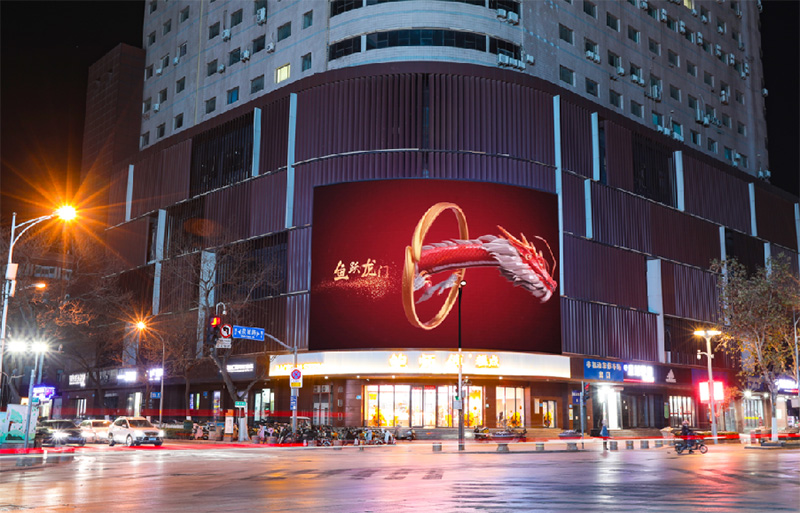
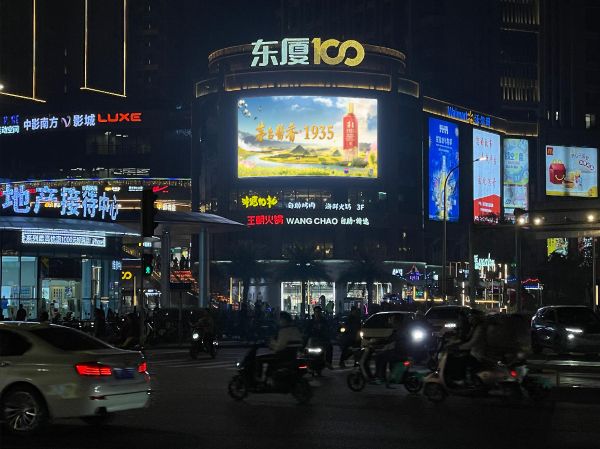
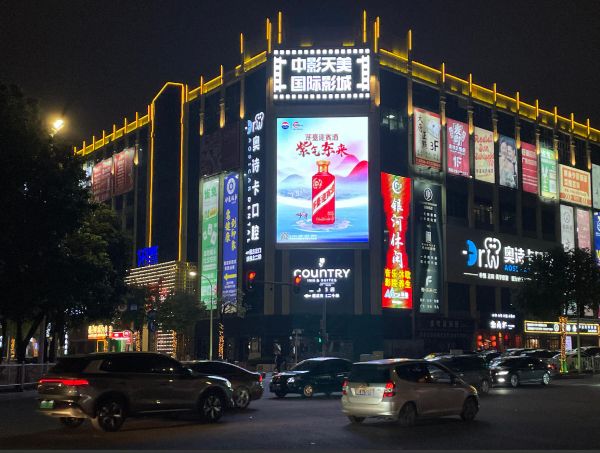
This type of screen is usually located in the core business district or transportation hub of the city, with a huge but fast flow of people. The audience's stay time is uncertain, but the visual impact is extremely strong. For this type of screen, the focus of the strategy should be on increasing daily exposure frequency. The duration of a single advertisement can be controlled at around 15 seconds, but it is necessary to purchase sufficient rotation times (such as 60-120 times per day) to ensure that enough attention is captured in the continuous flow of people. The overall advertising cycle can be relatively flexible, with campaigns lasting 1 to 3 months being more common.
Smart screens for office buildings and community elevators
This is a typical "closed space, fixed audience" scenario. The target audience is relatively fixed, and there are multiple and regular opportunities to reach them every day. In the brief enclosed and boring space of elevators, advertising attention is naturally higher. Therefore, for elevator screens, the core strategy is to pursue high-frequency repeated touchpoints. Very suitable for signing long-term contracts for quarters or half a year, utilizing the daily scenes that the audience must pass through, embedding brand information into their minds like a "nail" through 8-12 repeated exposures per day. Less than a month of advertising has little effect here.
Large screen of traffic artery gantry
This type of screen is facing high-speed moving traffic. The driver's attention is highly focused on the road conditions, and the time allotted for advertising is only a short 2-3 seconds. Therefore, advertising information must be extremely concise and easy to understand at a glance. In terms of advertising strategy, the duration should focus on covering important time periods throughout the day and maintaining a relatively long total advertising cycle (recommended to be more than 2 months). By accumulating time, it compensates for the shortcomings of insufficient depth in a single exposure, allowing information to be remembered through repeated passes.
Step 3: Scientifically formulate "frequency" and "cycle"
This is the key computational step in matching goals with resources.
Frequency setting: According to classic advertising theory, an audience who is exposed to advertisements 3-5 times in a short period of time can usually establish effective memory. For outdoor large screens, considering that the audience is in a non focused public environment, it is recommended to set the effective frequency target at 5-7 times per week per person. This means that you need to reverse calculate how many rounds you need to purchase to achieve this weekly average frequency target based on the traffic data provided by the screen points.
Cycle calculation:
Short term testing: If you are trying a certain location for the first time or have limited budget, you can first conduct a "1-2 week" short-term placement as a market test. Simultaneously closely monitor indirect indicators such as brand search volume and social media volume during the same period, and collect preliminary feedback.
Mid term Campaign: For most brand building and product promotion goals, "1-3 months" is a scientific and universal cycle. It can fully cover a consumer's cognitive, interest, and decision-making cycle, and span multiple weekends and holidays, reaching audiences in different life scenarios.
Long term occupancy: For industry leading brands or those aiming to establish brand barriers by monopolizing a core landmark for a long time, a long-term contract of "six months to one year" is often a more cost-effective strategic choice. Long term cooperation usually results in more favorable unit prices from media outlets and can achieve sustained suppression of competitors.
Step 4: Make dynamic adjustments based on the budget
Budget is the most realistic constraint. A practical "budget duration" balance thinking is:
(Total budget)=(Screen unit price x daily playback times x advertising days)
You need to make wise trade-offs in this equation:
When the total budget is fixed: you can choose to extend the overall cycle while reducing the daily playback frequency (fine water long flow mode), or shorten the overall cycle but significantly increase the daily playback frequency (concentrated bombing mode). The former is more conducive to the gentle sedimentation and long-term memory of the brand, while the latter is more suitable for the instant detonation of event marketing.

Three common misconceptions that must be guarded against
Misconception 1: Only ask about the total duration, not about the frequency of exposure.
Misconception: "I only need to invest for one month
Professional analysis: Was it only played twice a day during late night or 200 times during prime time this month? There is a difference in the effectiveness between the two. The 'total advertising cycle' must be evaluated in conjunction with the 'daily effective exposure frequency' in order to have practical significance.
Misconception 2: Believing that the longer the advertising time within a day, the better.
Misconception: "If I buy a 24-hour broadcast, someone will always be able to see it
Professional analysis: The early morning hours are rarely visited by people, and their exposure value is extremely low, which is a serious waste of budget. A smart strategy is to focus firepower (budget) on peak commuting hours, lunchtime, weekends, and holidays. Pursuing "effective duration" rather than "absolute duration" is the key to improving cost-effectiveness.
Misconception 3: One time delivery without monitoring and optimization.
Misconception: "Outdoor advertising cannot be tracked, just wait after signing the contract
Professional analysis: Although it is not possible to track real-time clicks like digital advertising, it can be evaluated through indirect indicators such as monitoring changes in the search index of brand keywords during the advertising period, the growth of brand mentions on social media, and inquiries from in store customers. During the months long advertising campaign, it is necessary to flexibly adjust the subsequent materials or time period strategies based on mid-term feedback data.
Conclusion and final recommendations
Returning to the original question: "How long is the best time to invest in outdoor large screen advertising
The ultimate answer is that it is a systematic and dynamic decision-making process, rather than an isolated and static time number.
For first-time advertisers, we offer a universal and secure starting suggestion:
Firstly, clarify your core goal (whether to ignite an event or shape a brand), and then choose a high-quality location that is highly matched with the target audience. On this basis, develop an initial plan of "at least 4 weeks, ensuring coverage of core periods such as morning and evening peak hours every day, and a daily effective exposure frequency of no less than 60 times". This plan can not only avoid a short cycle without any market impact, but also effectively control the initial investment risk, leaving ample space for observation and data collection to guide your next decision-making.
Please always remember that outdoor screens are the long-term occupiers of brand mentality. Its core value lies not in bringing instant clicks, but in building a strong brand image and trust for consumers in the vast urban public space through scientifically planned time dimensions and spatial occupancy. Wisely planning the duration and pace of advertising is the ultimate art of maximizing the return on investment of every advertising budget.