Outdoor advertising display screen: in-depth analysis of types, prices, and effects
2025-12-23Tianci MediaViews:256
Highlights
This article is the ultimate guide for outdoor advertising display screens, detailing the differences between LED screens, LCD screens, and other types, core purchasing parameters, advertising strategies, and budget planning. Help beginners avoid common pitfalls and introduce how to efficiently execute through the Tianci Media advertising platform. Read now and master the key to winning outdoor advertising!
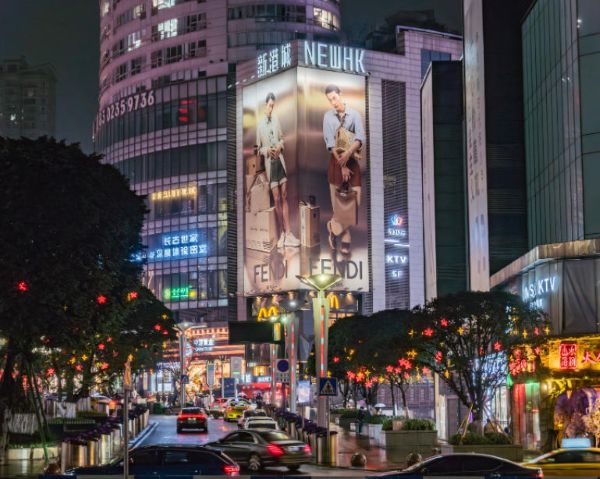
When you walk on the streets of the city, the giant screens that light up the city's night view and roll out dazzling images are the king of modern outdoor advertising - outdoor advertising display screens. It is no longer a simple information bulletin board, but a comprehensive medium that integrates light and shadow art, data technology, and scene marketing. For advertisers who want to reach vast offline traffic and establish a strong brand image, understanding and utilizing this medium has become a compulsory course.
This article will systematically dissect all aspects of outdoor advertising display screens, from basic cognition to advanced strategies, teaching you step by step to make wise decisions.
一、 The core value of outdoor advertising display screens: why is it irreplaceable?
In today's world where digital advertising is ubiquitous, the vitality of outdoor advertising displays has become increasingly strong, and their core values lie in three "mandatory" aspects.
1. Scene forced exposure
In specific physical spaces such as commercial districts, transportation hubs, and landmark buildings, display screens occupy the visual focus. Pedestrians or vehicles cannot "turn off" or "skip" it, and this location-based forced reach is incomparable to online advertising.
2. Visual impact and creative carrying capacity
High brightness and high-definition large-sized dynamic images can bring a stunning visual experience, perfectly carrying brand blockbusters, creative interactions, and other content, shaping a high-end and technological brand image.
3. Localization and scenario based marketing
By combining specific geographical locations (such as promoting new films next to cinemas or reminding customers to rest at gas stations), highly accurate scene based information push can be achieved, directly driving offline behavior (such as in store consumption).

二、 Main types and selection criteria of outdoor advertising display screens
The first step in choosing is to understand what equipment is in the 'arsenal'. It is mainly divided into the following categories:
(1) Analysis of mainstream display screen types
1. LED display screen
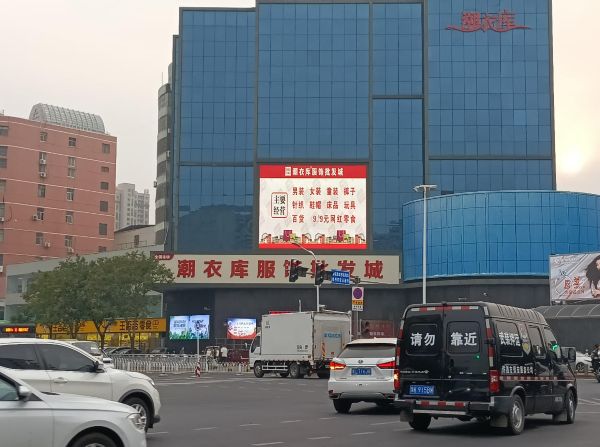
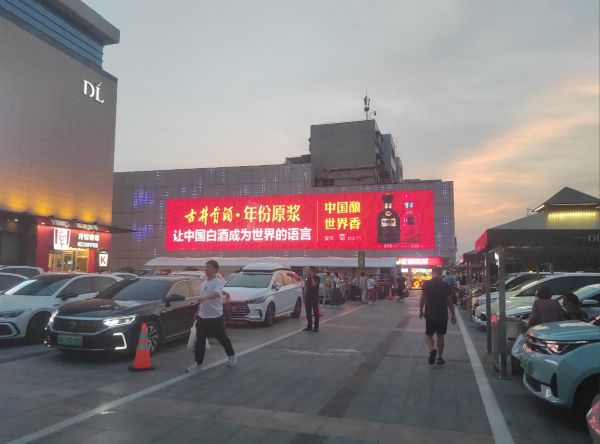
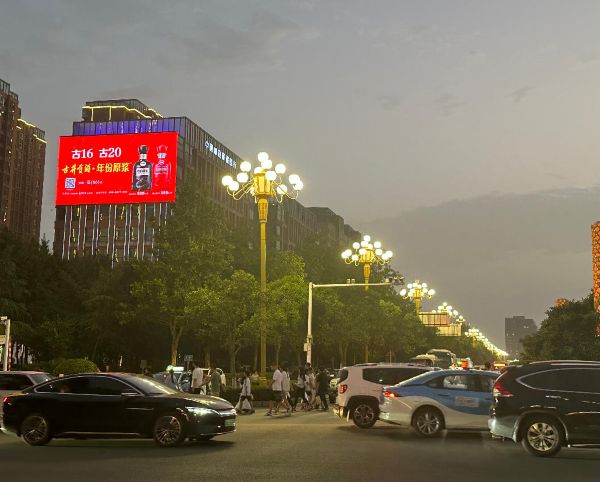
At present, the absolute mainstream is composed of countless LED modules spliced together.
Advantages: seamless splicing, flexible size, high brightness (resistant to direct sunlight), strong weather resistance, long service life.
Applicable scenarios: Large scale advertisements on building exterior walls, large screens in squares, highway billboards, etc.
Key parameter focus points: pixel spacing (P value, such as P10, P6. The smaller, the clearer), brightness (cd/m ²), refresh rate (to prevent scan lines from appearing during shooting).
2. LCD display screen (outdoor advertising machine)
Essentially, it is a reinforced giant LCD display.
Advantages: Bright colors, delicate graphics, high resolution, suitable for playing detailed graphic and textual videos.
Applicable scenarios: Semi outdoor or crowded areas with close viewing distance, such as subway stations, elevator entrances, mall courtyards, and entrances to chain stores.
Key parameter focus: brightness (higher than indoor models), waterproof and dustproof level (IP level), heat dissipation performance.
3. DLP projection (and laser projection)
Create a super large image through projection technology.
Advantage: It can be projected onto irregular carriers (such as building contours, water curtains) to create immersive light and shadow shows.
Applicable scenarios: Landmark building 3D projection shows, temporary performances for large-scale events, and creative themed exhibitions.
Attention: High requirements for ambient light, usually the best effect at night, and high operating and maintenance costs.
(2) Five step purchasing decision-making method
Faced with numerous choices, you can make decisions according to this process:
Step 1: Clarify the communication objectives and scenarios
Ask yourself: Is it mainly for brand image display or promotional information notification? Will the screen be placed at a bustling intersection or next to the community elevator? The target and scenario determine the type and specifications.
Step 2: Determine key performance parameters
Viewing distance: determines the pixel spacing (P-value). Remote viewing (such as building screens) can be selected from P10-P20; Close range (such as subway passages) requires P4 or even small spacing LED/LCD.
Environmental brightness: High brightness (≥ 5000 cd/m ²) LED is required for outdoor direct lighting environments; An LCD with slightly lower brightness can be selected for semi outdoor backlighting.
Content format: Mainly featuring dynamic videos, requiring high refresh rates; Mainly focus on static graphics and text, and pay more attention to color consistency.
Step 3: Evaluate installation and operation conditions
Consider the load-bearing capacity of the installation structure, power supply, heat dissipation requirements, and accessibility for later maintenance (such as module replacement). This requires a professional engineering team to evaluate.
Step 4: Conduct a comprehensive evaluation of suppliers
Examine suppliers' engineering cases, qualification certification, product quality (such as branded LED beads), and after-sales service capabilities. Don't make decisions based solely on price.
Step 5: Content and Scheduling Planning
The screen is the 'hardware', content is the 'soul'. Plan content creativity, playback frequency, and schedule in advance. Many professional service providers, such as Tianci Media Advertising Company, can provide one-stop services from hardware operation and maintenance to content arrangement, greatly reducing the burden on advertisers.

三、 Guidelines for advertising strategy and maximizing effectiveness
How to maximize the effectiveness of owning or renting a high-quality display screen?
(1) The Golden Rule of Media Location Selection
Human traffic and crowd profiling: Prioritize selecting areas where target customers gather. If high-end products target CBD, fast-moving consumer goods cover residential areas and commercial districts.
Visual dwell time: Choose locations where people will naturally stop, such as red light waiting areas, bus stops, elevator waiting areas, etc.
Visual clarity: Avoid areas severely obstructed by trees, overpasses, or other billboards to ensure that the screen has a sufficiently wide field of view.
(2) The "3-second principle" of content creativity
In outdoor environments, the audience's attention is extremely limited. Effective communication should be completed within 3 seconds for the content:
Super symbol: Use strong brand visual symbols (logo, mascot, standard colors).
Large font with few words: The core information is concise and powerful, the font is large enough, and it can be recognized from a distance.
Dynamic attraction: Reasonable dynamic effects (not random flickering) can capture the eye in the first time.
Situational integration: Designing content that is harmonious or creates clever contrasts with the surrounding environment.
(3) Technology Empowerment: From Static Display to Intelligent Interaction
Modern outdoor display screens are evolving towards intelligence:
Internet Broadcast: Through centralized management systems such as Tianci Media's advertising platform, it is possible to remotely update the content of hundreds or thousands of screens with just one click, achieving rapid synchronization of nationwide campaigns.
Data driven: By integrating cameras (anonymized processing) or sensors, it is possible to roughly count the flow of people, viewing time, and even automatically switch playback content based on weather and time (such as pushing rain gear advertisements on rainy days).
Interactive experience: Combining QR code and AR technology, guide the audience to scan the code and participate in interaction, achieve traffic flow from offline to online, and make the effect traceable.
四、 Budget Planning and Common Investment Misconceptions
(1) Transparency of cost composition
The overall cost usually includes:
Media rental fee/occupancy fee: Core cost, charged based on location, area, and duration.
Production and publication fees: the cost of content design, video production, and actual screen installation.
Electricity and maintenance costs: Electricity and daily maintenance and repair costs for the operation of the display screen.
Platform service fee: If delivered through agency platforms such as Tianci Media, it may include comprehensive service fees for strategy, procurement, monitoring, etc.
(2) Three major misconceptions that must be guarded against
Misconception 1: "As long as the screen is large enough, the effect will definitely be good
Neglecting location and the quality of pedestrian flow, standing a giant screen in a remote area is a huge waste. Location always comes first.
Misconception 2: Content not updated for a long time
Playing a set of content for several months can create a "visual blind spot" for the audience, rendering it ineffective in advertising. A reasonable frequency of content updates should be maintained.
Misconception 3: Lack of effectiveness evaluation and optimization
Do not pay attention after advertising. We should evaluate the effectiveness and provide a basis for subsequent optimization by combining offline research, changes in brand search index, and interactive QR code scanning data.
五、 Conclusion
Outdoor advertising display screens are powerful speakers for brand and urban public dialogue. Successful advertising is a comprehensive project that integrates site selection science, hardware technology, creative art, and data thinking.
For brands with limited resources or those looking to launch projects more efficiently, partnering with professional comprehensive service providers is a shortcut. The value of institutions like Tianci Media's advertising placement platform lies in providing a full chain solution from high-quality media resource library, professional hardware operation and maintenance to creative content advice and intelligent scheduling management, allowing you to focus more on the brand strategy itself.