Detailed Explanation of Core Locations for Outdoor Large-Screen Advertisements at Daxing Airport and Analysis of Audience Reach
2025-12-16Tianci MediaViews:283
Highlights
Deeply analyze the core value, specific location, creative strategy, deployment process, and cost-effectiveness of outdoor large-screen advertisements at Beijing Daxing International Airport. Provide brand owners with a practical guide from beginner to proficiency, helping you decide whether to deploy this "national gateway" media. Get the complete guide now!
In the era of information explosion, it has become increasingly difficult for brands to be remembered. However, at Beijing Daxing International Airport, there is a type of media that can instantly "penetrate" the information filtering barriers of passengers with its absolute physical presence and visual dominance - this is outdoor large-screen advertising. It is not only an advertising space, but also a symbol of brand strength, and a "national gateway" stage for high-net-worth passengers worldwide. But for many marketers, where exactly is it located? How to invest in it? How to measure its effectiveness? This guide will provide you with a clear and actionable complete solution.
Chapter 1: Value Proposition - Why is it the "Nuclear Weapon" of Brand Communication?
Before evaluating any media, it is essential to first comprehend its irreplaceable core value.
1. Absolute monopoly of attention
In the specific enclosed environment of an airport, passengers find themselves in a state of "mobile waiting". Giant LED screens spanning tens or even hundreds of square meters naturally become visual focal points with their high-definition dynamic images and bright colors, achieving almost compulsory reach and escaping the dilemma of online ads being easily swiped away.
1. Top-tier brand endorsement and scenario empowerment
"I saw your advertisement on the big screen at Daxing Airport" - this sentence itself carries significant word-of-mouth effect. It conveys the brand's strong capabilities, high-end positioning, and market confidence. The grand architectural space where the screen is located further enhances the brand's sense of excellence and international image.
1. Precisely cover high-value traffic pools
The screen targets a group of business travelers, vacationers, and international individuals with an annual throughput of tens of millions. They generally possess the characteristics of high income, high education, and high consumption power (the "three highs"), making them ideal customers for industries such as automobiles, finance, technology, luxury goods, and high-end tourism.
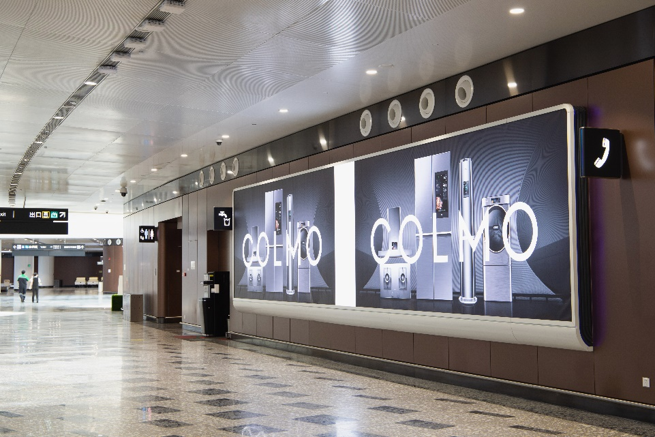
Chapter 2: Detailed Resource Explanation - Core Locations and Scenario Analysis
"Outdoor large screen" is a general term, and its value varies greatly depending on its location.
1. Core golden point (traffic hub)
Location: Main screen in the core area of the check-in hall for international/domestic departures on the fourth floor.
Scene and audience: The essential place for all passengers to check in, with the highest density of people and relatively longer stay time (waiting in line for check-in, searching for check-in counters). The audience is at the beginning of their journey, with an open mindset, and is easily receptive to brand information.
Value: With the highest traffic volume, it is the preferred choice for brand exposure, suitable for overall shaping of brand image and making a strong statement.
2. Key path point (precise interception)
Location: Large screen above the front passage of the security checkpoint and the main road leading to the boarding gate.
Scene and audience: After completing check-in, passengers are on their way to the security checkpoint or boarding gate. At this time, they have relatively ample time, and their gaze naturally seeks directional signs, making screens easily come into view.
Value: High-frequency reach and deep penetration, suitable for key product promotions or release of promotional information.
3. Arriving at the designated area (shaping first impression)
Location: Main screen in the international/domestic baggage claim hall.
Scene and audience: When travelers arrive in Beijing and are waiting to collect their luggage, they are paying close attention. This is a golden opportunity to shape their "first impression of Beijing" or promote local services such as hotels, transportation, tourism, and real estate.
Value: Accurately align with and fulfill practical needs, inspire and guide subsequent consumer behavior.
Chapter 3: Full-process Guide for Launch
Step 1: Clarify the objectives and define the budget
Brand goal: Is it about market launch and ignition, anniversary celebration, product release, or continuous brand positioning?
Communication goal: Pursue maximum exposure (CPM), or pursue deep influence in regional markets or specific demographics?
Budget preliminary exploration: Large-screen advertisements at Daxing Airport are typically priced on a weekly/monthly basis, representing high-end media investment. It is necessary to initially frame the budget range based on the target, and generally requires media preparation starting at the million-yuan level.
Step 2: Creative Strategy and Content Production
This is the key to determining the return on investment. The "big screen" mindset is crucial:
Prioritize visuals, adhere to the 3-second rule: Abandon complex copywriting. Rely on strong visual symbols, minimal yet powerful slogans, high-quality brand logos, or product imagery to convey core information within 3 seconds.
Dynamic narrative: Leverage the strengths of video. A 15-second short film possesses greater appeal and storytelling tension than static images.
Scene integration: Creative content can be combined with emotional points such as "journey", "departure", "arrival", and "international" in the airport to evoke emotional resonance from the audience.
Technical specifications: Strict adherence to the technical requirements provided by the media party, such as resolution, format, and bit rate, is essential to ensure clear and smooth broadcast quality.
Step 3: Agency communication and execution confirmation
Selecting an agent: Confirm that the advertising company possesses first-level or second-level formal agency qualifications for Daxing Airport media.
Proposal and quotation: Require them to provide a formal proposal that includes specific locations, screen sizes, pedestrian flow data, release time, detailed quotation, and scheduling guarantee.
Contract and publication: Clarify the contract terms, especially the monitoring terms for publication (requiring the provision of photos/videos of the first-day monitoring broadcast). Confirm the complete timeline for material submission, review, and release.
Step 4: Effect monitoring and integration amplification
Offline effect: Ensure flawless execution through on-air monitoring. Combine with offline activities (such as pop-up stores under screens) or set up exclusive interactive QR codes (such as directing to the brand's official account or mini-program) for effect transformation and traffic reception.
Online amplification: Transform large-screen advertising content into high-quality short videos and posters, and disseminate them on social media for secondary promotion, creating an integrated marketing effect of "offline ignition and online fermentation".

Chapter 4: Three Common Misconceptions and a Checklist for Avoiding Pitfalls
Misconception 1: Focusing solely on "big" while neglecting location and context. Not all large screens have equal value. The audience psychology and reach effectiveness of screens in check-in halls and arrival corridors vary significantly, necessitating precise selection based on the target audience.
Misconception 2: Creative "Small Screen Adaptation" Translation. Directly transferring long images from mobile detail pages or TV ads to large screens is a fatal mistake. Exclusive creative designs must be tailored for outdoor environments characterized by "long distances, short durations, and strong disturbances.".
Misconception 3: Regarding it as a short-term sales tool. The evaluation of the effectiveness of large-screen advertising should focus on medium and long-term indicators such as brand awareness enhancement, high-end image building, and market confidence establishment, rather than directly pursuing short-term sales conversion. It is like "air force bombing", opening up battlefields for ground forces (sales channels).
Chapter 5: Conclusion and Call to Action
The outdoor large-screen advertising at Daxing Airport represents a concentrated release of brand potential energy, engaging in a silent yet powerful dialogue with the most valuable demographic. It may not be suitable for all brands, but it is ideal for those with lofty ambitions, who aspire to set industry benchmarks and vie for the commanding heights of user perception.