What is the scope of community advertising? A must-have practical manual for novice coverage radius decision-making
2026-02-13Tianci MediaViews:136
Highlights
What is the scope of community advertising? A must-have practical manual for novice coverage radius decision-making
Friend, have you ever had such an experience——
The new store opened with great ambition, thinking to myself: since we're advertising, we'll cover the whole city!
So I chose 50 communities, scattered all over the country, with a budget that was spent completely.
Review after a month: Money is gone, what about the customer flow in the store? It doesn't seem to have increased much.
Where is the problem?
It's not that you didn't cast enough, it's that you cast too loosely.
How large is the scope of community advertising? This question may seem simple, but 80% of beginners stumble here.
The pitch is too wide, like sprinkling pepper. Each community has only touched a little bit, and no one remembers you.
The coverage is too narrow, and the store is waiting for customers every day, feeling lonely.
Today's article will thoroughly discuss this matter.
Don't mess up those complex model formulas, it's like two friends who open a shop drinking tea and chatting - helping you calculate this account clearly.

Chapter 1: Understanding the Scope of Community Advertising: What exactly does it encompass?
Before answering 'what size to choose', we need to first clarify a more fundamental question:
The scope of community advertising is not the circle on the map, but the trajectory of human activities.
The first range: geographical radius.
Where is your store located? The surrounding community within a few kilometers is your natural source of customers.
3 kilometers? 5 kilometers? Or the whole city?
It's not determined by a snap of the head, it's determined by what you sell.
The second category: commuting routes.
You live in Huilongguan, but work at Guomao. Your daily activity trajectory is: going out → subway station → company.
The advertisements you see in the Huilongguan community and the advertisements you see at the Guomao subway station are both 'effective outreach'.
The scope of community advertising is not only limited to the circle around your doorstep, but also includes the roads you pass through every day.
The third scope: relational circle layer.
You placed an advertisement in A community, and the owner saw it and thought it was good. I casually mentioned going to my parents' house for dinner on the weekend.
My parents live in B community, which is 10 kilometers away from you.
Your advertising scope has quietly extended to 10 kilometers away through interpersonal relationships.
So you see, the question of 'what is the scope of community advertising?' is essentially asking:
Does your business rely on people who "come by" or people who "remember"?
The former looks at geographical radius, while the latter looks at mental radius.
Chapter 2: Three Tables to Help You Calculate Your Golden Range
Let's not talk nonsense, let's go straight to practical experience.
Step 1: First, look at your business model and set a benchmark radius.
What is the recommended benchmark radius for business types?
Convenience stores, fruit shops, and dry cleaners are within 500-800 meters, and no one is willing to walk 1 kilometer to buy a bottle of water
Community dining, hair salons, and pharmacies require a psychological threshold of 1-1.5 kilometers by bike/walk for 10 minutes
Education and training, fitness center 2-3 kilometers away. Parents are willing to take a few more steps for their children
Home decoration and car maintenance require 3-5 kilometers of low frequency and high cost consumption, which is acceptable even from a distance
Brand flagship stores and high-end services are driven by reputation and brand power throughout the city
If you are opening a new store and haven't figured out your radiation ability yet, start testing from the lower limit of the benchmark radius.
Step 2: Look at your competitive environment and adjust the scope.
The reference radius is an ideal state, but in reality there are two variables that can 'flatten' it:
Variable 1: Competitors.
There is a similar store located 500 meters away from your shop, and it has been open for 5 years with a stable reputation.
At this point, if you only throw 500 meters, it's like competing for food at someone else's home ground, which is difficult.
What should I do?
Either shrink - give up widespread coverage, concentrate firepower on the 200 meters outside your doorstep, and achieve the highest entry rate.
Either expand - jump 1.5 kilometers away and find a new blank area where there are no competitors or where competitors are weak, and first occupy the minds of the users there.
Variable 2: Natural barriers.
A major road without zebra crossings, an impassable overpass, a railway line - these are all invisible 'range terminators'.
On the map, it looks like 1 kilometer, but in reality, it takes about 15 minutes to cross the road. This 1 kilometer is an invalid range.
What should I do?
Take a map and walk it with your feet. Don't just look at the straight-line distance, look at the actual walking/riding route.
Step 3: Look at your budget and deduce a reasonable range.
This is the cruelest and most realistic step.
Assuming you have a budget of 30000 yuan and want to advertise in the surrounding community.
A mid-range community's single block framework has a monthly average price of approximately 500-800 yuan. 30000 yuan, with a maximum investment of 40-50 yuan.
Two extreme solutions:
Plan A: Invest in 50 communities, with one screen per community, covering the entire city.
Plan B: Invest in 10 communities, with 5 screens per community, for saturation attacks.
Which one?
The answer is: it depends on your goal.
If the goal is to "let the most people know that a new brand has opened here" - choose A. Although I can't remember you, I'm familiar with you.
If the goal is to make the owners of these 10 communities think of you first when they want to eat, choose B. Community advertising is a frequency game, not a coverage game.
Advice for beginners: When the budget is limited, it is better to narrow down the scope and increase the density, rather than being greedy for bigger things.
Chapter 3: Three Real Cases to See How Others Choose
Case 1: A new skewer fragrance store in Chengdu
Business format: Community catering
Budget: 50000
Reference radius: 1 kilometer
Problem: There are 8 hot pot/skewers within 1 kilometer, and the competition is fierce
Their choices:
Not just 1 kilometer in length, but reduced to 500 meters and fully enclosed the unit entrance hall frames of three large communities in the surrounding area.
Each community invests 6-8 screens, and homeowners have to wait for the elevator to enter and exit every day, even if they don't want to.
Result: In the first two weeks before opening, these three communities contributed 65% of the foot traffic to the store. One year later, two competitors within a 1-kilometer radius collapsed, but they are still driving.
Case 2: A children's English institution in Beijing
Business format: Education and Training
Reference radius: 3 kilometers
Problem: There are 11 competitors within 3 kilometers
Their choices:
I didn't struggle within 3 kilometers, but jumped 5 kilometers away and found a large residential area.
There are no well-established children's English brands in this area, but the housing prices are high and the family structure is young, resulting in strong demand.
Result: Half a year later, this campus that "jumped out" became the most efficient in the entire company.
Case 3: A high-end home decoration company in Hangzhou
Business format: Low frequency high consumption
Reference radius: 5 kilometers
Problem: The brand is well-known, but the in store rate has not been able to increase
Their choices:
Not expanding the range, but doing deep single point concentration.
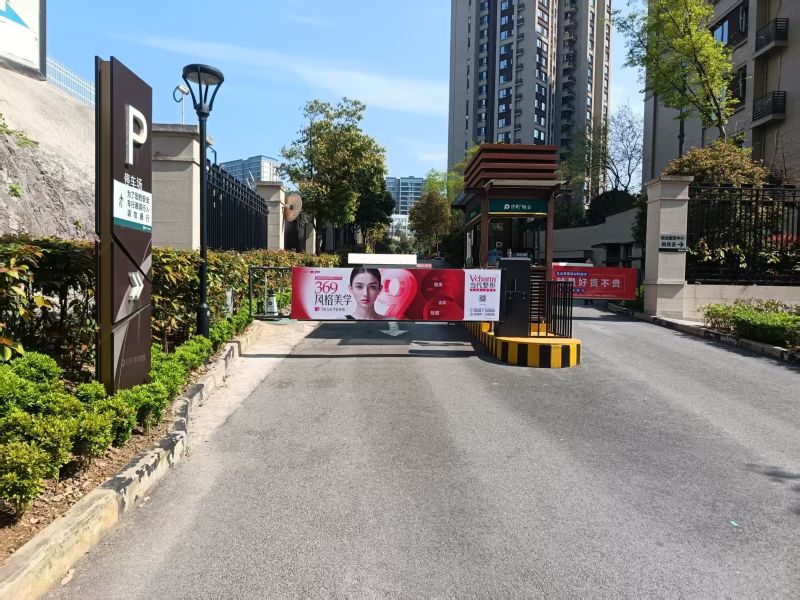
We have selected three core delivery properties, not just elevators, but elevators, barrier gates, access control, and express cabinets that are fully enclosed.
The owner is surrounded by the same brand from leaving the house to returning home.
Result: The signing conversion rate of these three properties is three times higher than that of other channels.
Chapter 4: The 4 easiest range traps for beginners to step on
Trap 1: Being fooled by "covering the whole city".
Our plan covers 200 communities throughout the city! "- sounds impressive.
But if you take a closer look: 200 communities, each with only one screen, are still the most biased positions.
Owners come in and out every day. Today they see your home, tomorrow they see competitors, and the day after tomorrow they see completely unrelated brands.
Your advertisement is submerged in information junk, and no one remembers you at all.
Remember: Community advertising is not a stamp collecting game. It's better to invest 5 yuan each in 3 communities than 1 yuan each in 15 communities.
Trap 2: Only the coverage radius is considered, not the competition radius.
Your benchmark radius is 3 kilometers, but there are 10 peers advertising within 3 kilometers.
At this moment, rushing in is like shouting and screaming in someone else's living room.
The correct approach is to conduct a competitive analysis first.
Which communities did your peers invest in within these 3 kilometers?
What position did they cast? Framework or barrier?
What are their visual styles and selling points?
Either look for communities they haven't covered, or look for communities they have covered but haven't fully explored.
Trap 3: Ignore the 'overflow of flow lines'.
The 5 communities you have selected are all within 1 kilometer of your store, theoretically perfect.
But you find that the passenger flow is still not enough.
Why? Because you only looked at 'where do you live' and didn't see 'where do people go'.
You live in community A, but work in business district B. You go out in the morning, go home at night, and are not at home for more than ten hours in between.
The time when community advertisements reach you is a few minutes in the morning and evening, but your consumption decisions may occur at noon or on the road.
What should I do? While covering residential communities, add some advertisements for commuting routes such as subway stations, bus shelters, and community bus stops.
Trap 4: Treating the 'scope' as the 'endpoint'.
The mindset of many beginners is: once the scope is set, the advertisement is published, and the task is completed.
No. Defining the scope is just the beginning.
After the advertisement is published, which community does the QR code data come from?
Which community name should be listed for the customer flow entering the store?
Which sections are the delivery addresses for group buying orders concentrated in?
These are all live data that will tell you: is your true radiation range the same as the circle you drew back then.
By adjusting the scope with data, the next round of advertising will become more accurate.
Chapter 5: A Formula to Help You Calculate Your Optimal Range
After reading so many cases and methods, if you're still unsure, let's go to the ultimate weapon——
A simple range calculation formula:
The optimal number of coverage communities=(total budget ÷ suggested budget for a single community) × density coefficient
Suggested budget for a single community (reference value):
Only investing in elevator frames: 3000-5000 yuan/month
Elevator+barrier gate combination: 6000-8000 yuan/month
Community wide surround: 10000-15000 yuan/month
Density coefficient:
New store opening, requiring quick explosion: 0.8 (priority to ensure single point concentration)
Regular brand maintenance and continuous exposure: 1.2 (can be expanded appropriately)
Competitors already have a preconception: 0.6 (first deepen, then expand)
For example:
You have a budget of 50000 yuan and plan to invest in an elevator framework (with a budget of 4000 yuan per community). It is a new store opening (with a density coefficient of 0.8).
50000 ÷ 4000=12.5
12.5 × 0.8 = 10
Suggested coverage of communities: 10.
With this basic number, make adjustments based on the competitive environment, natural barriers, and external flow.
At the end: Scope is a strategy, not a goal
When I first entered the industry, I said a sentence with my seniors that I still remember until now:
How large is the advertising range? It's not a math problem, it's a multiple-choice question
Math problems have standard answers, while multiple-choice questions do not.
You choose 3 kilometers, there are 3 kilometers of play.
You choose 5 kilometers, there are 5 kilometers of play.
You choose city wide coverage, and there are also strategies for city wide coverage.
What I'm afraid of is not making the wrong choice, but choosing a 3-kilometer strategy and only pitching in 5 communities; I chose the budget for the whole city, but only made a superficial effort.
The biggest fear is that I haven't figured out why I chose this range from beginning to end, just 'I think it should be this big'.
If you are struggling with how wide to choose for community advertising, my suggestion is:
Start from a small to error free range.
1 kilometer. Three communities. Full surround placement. Run for 4 weeks.
Get first-hand data - which community has the highest store entry rate? Which point scans the code the most? When are homeowners most willing to interact?
Then, use the knowledge gained from these 4 weeks to guide the next round of 3 kilometers, 5 kilometers, and even the entire city.
This is not slow, this is fast.
If you still feel uncertain, especially when it comes to your first investment, you don't know what range to choose, what combination to choose, or how to judge the effect——
Why don't you talk to friends from Tianci Media.
They have been running in the field of community advertising for over a decade, serving thousands of brands in catering, education, home decoration, automobiles, and local life. They have a clear understanding of what format is suitable for what radius, what budget is matched with what density, and have a clear mind.
You don't need to become a community advertising expert.
You just need to find someone willing to stand outside your store and help you draw a clear circle.
Then, start with a small, precise circle.
Let every budget go to the nearest customer on their way home.