How to get billboards straight to your doorstep? 5 steps to achieve efficient and precise placement of community advertising
2026-02-11Tianci MediaViews:169
Highlights
This article provides a complete guide for advertisers to place community billboards, deeply analyzing their irreplaceable localization value, mainstream advertising space types, and providing practical steps from precise point selection, creative design to effect tracking. Read now to obtain professional solutions for efficiently reaching target community families.
In today's era of constantly emerging digital marketing methods, a seemingly traditional medium - community billboards - is once again becoming a strategic location for brands to reach core consumer units (households) with its irreplaceable advantages of "proximity" and "trust". It is not like online advertising that can be skipped with just one click, nor does it require a huge budget like big brands in bustling commercial districts. It stands quietly on the daily home route that residents must pass through, completing precise and high-frequency communication in the closest place to life.
For brand owners who pursue stable customer flow conversion and deep cultivation of regional markets, understanding and making good use of community billboards is a key step in building an offline marketing moat. This guide will systematically analyze the core logic, execution strategies, and pitfalls of community billboards from the perspective of investment decision-making.
Chapter 1: Value Re evaluation: Why Community Billboards are the Foundation of Local Marketing?
1.1 The Four Irreplaceable Core Values
The value of community billboards is rooted in their unique physical and psychological location:
Ultra precise grid penetration: Advertisements are directly bound to specific residential communities, enabling extremely accurate screening and placement based on housing prices, age, number of households, and resident composition (such as young families and elderly communities), making it a typical "grid based" intensive media.
The final step in household consumption decision-making: Communities are the birthplace of large-scale or high-frequency household consumption decisions such as decoration, education, automobiles, housekeeping, and fresh food. Advertising reminders within the last 100 meters of home can directly influence payment decision-makers and drive consumer behavior.
Endorsement of a high trust "neighborhood" environment: In a familiar community environment, standardized and tidy physical billboards have natural territorial credibility compared to pop-up online advertisements. Long term and stable display can subtly establish a sense of brand familiarity and become a part of the 'community supporting facilities'.
High cost-effectiveness ratio and return on investment (ROI): Compared to outdoor billboards that cost millions of yuan, community billboards can achieve saturated and repetitive reach to a group of high-value and highly relevant target customers at a very reasonable cost, especially suitable for small and medium-sized enterprises and local service providers with limited budgets but pursuing practicality.
1.2 Five key dimensions for evaluating billboard value
To determine whether a community billboard is worth investing in, it is necessary to consider comprehensively:
Quality and scale of community residents: occupancy rate, housing price/rent level, household structure and consumption ability of residents.
Advertising space location and passenger flow line: Is it located on the core flow line that residents must pass through frequently every day (such as the main entrance and exit, unit lobby, garage elevator hall)?
Visual environment and interference level: Is the billboard itself neat and bright? Is there too much cluttered information interference in the surrounding area?
Mandatory media format: Is it a bulletin board that residents can selectively watch, or a frame advertisement that cannot be avoided in enclosed elevators?
Relevance to brand service scenarios: Home decoration brand advertisements appearing in newly delivered properties have higher value than appearing in old residential areas.

Chapter 2: Analysis of Mainstream Community Billboard Types and Resources
Community billboards are a collective concept, mainly divided into the following categories:
2.1 Elevator media (mandatory exposure of core areas)
Elevator car frame advertisement:
Location: Three or four sides of the elevator inner wall.
Characteristics and Value: Closed space, mandatory viewing, extremely high frequency of exposure (at least 2-4 times a day). Static images, relatively low cost, suitable for long-term brand positioning and core information dissemination.
Elevator door stickers/lintel advertisements:
Location: Inside and outside the elevator doors and above.
Characteristics and Value: Utilizing the dynamic opening and closing of elevators to attract attention, with ample room for creativity.
Elevator intelligent screen:
Location: Inside the elevator car or waiting hall.
Characteristics and Value: Dynamic audio-visual, stronger attraction; Remote management and support for time-sharing playback; It is the mainstream direction of current technological upgrades.
2.2 Entrance/Exit and Traffic Media (Traffic Checkpoint Area)
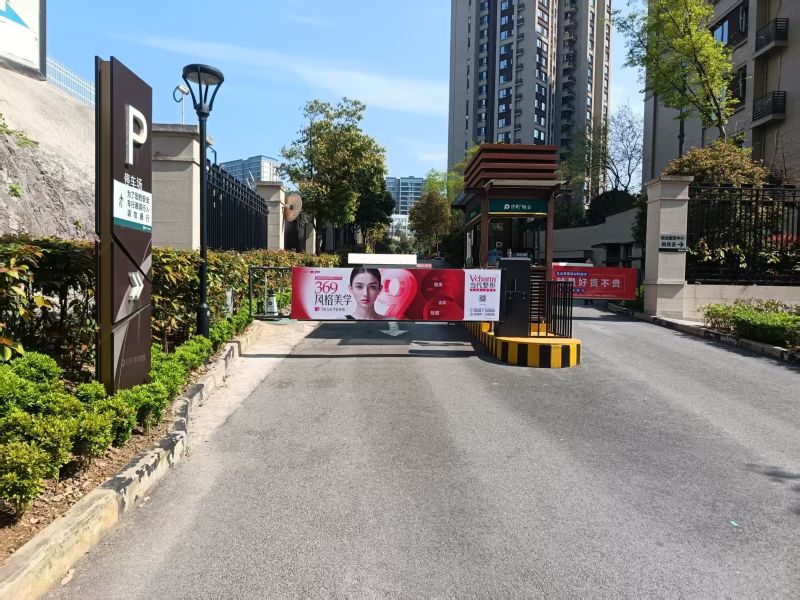
Community access control/barrier advertising:
Location: Vehicle and pedestrian entrance/exit gates.
Characteristics and values: Residents' daily "first and last eyes" when entering and leaving the community, with a strong sense of "returning home" ceremony and strong brand memory correlation.
Garage lightbox/signage advertisement:
Location: Underground garage entrance, passage, parking space signage.
Features and Value: Accurately reaching families with cars, communicating in parking and pick-up scenarios, suitable for brands related to automobiles, finance and insurance, tire maintenance, etc.
2.3 Public Space Media (Living Contact Area)
Community bulletin board/public welfare lightbox:
Location: Central Garden, Square, Next to Main Road.
Characteristics and Value: It combines public welfare and commercial attributes, has a spacious environment, may stay for a long time, and is suitable for establishing a good public image for the brand.
Unit lobby bulletin board/LCD screen:
Location: First floor lobby of residential building.
Characteristics and Value: Deeply penetrating the interior of the building unit, achieving the most accurate reach, with a relatively calm reading state, suitable for conveying in-depth information such as property notifications, high-end housekeeping, and children's education.
2.4 Innovative Interactive Media (Experience Connection Area)
Intelligent express cabinet advertisement:
Location: Community express cabinet body and screen.
Characteristics and Value: Collecting express delivery is a high-frequency and essential behavior of modern urban residents, with a high advertising reach rate and direct linkage with e-commerce promotional activities.
Community group buying self pickup point packaging:
Location: Convenience stores, post stations, and other self pickup points within the community.
Characteristics and Value: Integrating with the hottest community commercial scenarios, transforming traffic entry points directly into brand experience points and sales terminals.
Chapter 3: Five Step Practical Practice: The Complete Process of Scientifically Placing Community Billboards
Step 1: Clarify goals and create a 'community portrait'
Business objective clarification: Is it to divert traffic for newly opened community stores? Promote local lifestyle services (such as cleaning and maintenance)? Or to enhance the brand's visibility in a certain administrative region?
Target Community Profile: What kind of community does your client live in? Is it a high-end improvement project, a young and essential project, or an elderly community project? Transform target customer characteristics into specific and selectable community attributes (location, housing prices, number of households).
Step 2: Refine point selection and resource combination strategy
This is the core that determines the return on investment.
Community classification and matching:
High end commodity housing: Emphasis is placed on brand tone matching, and elevator intelligent screens and garage advertisements are high-quality choices.
Large mature communities: with a stable population base, suitable for multi-point and multi form saturation coverage.
Old residential areas: close neighborhood relationships, strong word-of-mouth effect, high cost-effectiveness of bulletin boards and elevator frames.
Resident flow analysis and point selection: Simulate the complete flow of residents from the community gate to the garage/unit building, elevator, and home, deploy advertisements at key nodes (such as barriers, elevator halls, and cars), and form a communication loop.
Utilizing professional platforms to achieve efficient screening and procurement: With a large number of communities and extremely dispersed resources. Collaborating with professional organizations like Tianci Media is a wise choice. Tianci Media is a professional community advertising placement company, whose core advantage lies in having a database and digital platform covering a massive number of communities. Based on your goals (such as "properties with a housing price of over 30000 yuan and an occupancy rate of over 80% in Chengdu High tech Zone"), you can quickly screen the matching community list, available advertising spaces, and real-time quotes, and provide one-stop cross community procurement and execution services, greatly improving efficiency.
Step 3: Creative Design: Designed for "Family Life" and "Slow Reading"
Community advertising is a close range, life oriented communication.
Clear points of interest, speak in human language: avoid complex and abstract concepts. Directly inform 'Exclusive price for homeowners in this community' and 'Teacher XX starts classes in the adjacent building'.
Visual symbols should be prominent: the brand logo, product packaging, and spokesperson image should be eye-catching. Colors should be warm, bright, and in line with family aesthetics.
Strong localization call and trust building: Clearly label "walkable" and "community contracted service provider", and place clear large-sized QR codes or contact phone numbers.
Emotional resonance: Text can be related to core family concerns such as "child education," "elderly health," and "home beautification.
Step 4: Budget Planning, Negotiation, and Contract Execution
Pricing model: Usually calculated on a "block/week" or "block/month" basis, with package prices for both residential and commercial properties. Price is strongly correlated with community level, urban area, and media format.
Suggested advertising cycle: It takes time to establish community trust and awareness. It is recommended to advertise for at least 4 weeks (one month) for the first time to achieve effective frequency coverage.
Key terms of the contract: Clearly stipulate the specific number of advertising spaces, publication time, image specifications, monitoring standards (provide publication photos), and renewal priority.
Step 5: Effect tracking and community relationship linkage
Offline to online (O2O) traffic tracking: Use QR codes with community number parameters to accurately count the number of scans, deposits, or orders brought by each community.
Store data verification: Collaborate with neighboring merchants in the community, customers can enjoy discounts with their advertising images, and directly verify the drainage effect.
Combining with community activities: If conditions permit, advertising placement can be combined with parent-child and festival activities organized by the property for ground promotion, achieving a combination of quality and effectiveness.
Chapter 4: Three Common Misconceptions and Pitfalls in Ensuring Investment Effectiveness
Misconception 1: Only focusing on cheap prices, neglecting community quality and matching.
Trap: Choosing old residential areas with the lowest prices but weak consumer power, or those that do not match their own brand positioning seriously, leads to ineffective exposure.
Countermeasure: Adhere to the principle of "precise matching is better than low-priced coverage". Strictly screen communities based on target customer profiles, pursuing effective outreach rather than just the number of points.
Misconception 2: Poor and shoddy design damages the brand image.
Trap: Using low resolution images, outdated fonts, and cluttered layouts to make advertisements appear "low" not only fails to attract customers, but also damages the brand's image in the minds of high-end community owners.
Countermeasure: Equip community billboards with professional designs to ensure that the images are concise, the information is clear, and the texture is good, and they blend harmoniously with the community environment.
Misconception 3: Lack of awareness of property compliance leads to risks in publishing.
Trap: Failure to formally report or sign a contract with the property management, or advertising content that does not comply with community management regulations, resulting in forced withdrawal after placement, causing financial losses.
Countermeasure: It is necessary to cooperate with the property management or its recognized advertising agency through formal channels. Professional companies like Tianci Media usually have established stable partnerships with a large number of properties to ensure the legality, compliance, and long-term stability of their advertising.
Conclusion
Placing community billboards is essentially a refined offline operation based on deep audience insights. It does not pursue temporary sensational effects, but is committed to building deep trust and habitual choices between brands and consumers through stable appearances in daily life scenarios.
The key to success lies in the ultimate matching of community resources, creative communication tailored to daily life, and reliable and standardized execution guarantees. For the vast majority of brands, it is better to rely on partners such as Tianci Media, who have strong resource integration capabilities, digital platforms, and professional service systems, rather than spending huge energy to explore and manage dispersed community resources on their own. This allows you to focus your energy on brand strategy and the product itself, ensuring that every marketing investment at your doorstep is accurately translated into actual customers and growth.
Now, it's time to re-examine and lay out your brand's marketing position in the community, a valuable oasis, from a professional perspective.