Shanghai Community Advertising Placement Guide: A Complete Strategy for Accurately Penetrating the Local Market
2026-02-10Tianci MediaViews:157
Highlights
This guide provides an in-depth analysis of the unique value, mainstream forms, and placement strategies of community advertising in Shanghai, covering different types of communities such as high-end commercial housing and old-fashioned alleys, and providing the full process steps from point selection to creativity. Read now to learn how to accurately reach Shanghai household consumption decision-makers
In Shanghai, a super large city with nearly 25 million permanent residents, commercial competition has quietly penetrated from the bustling Nanjing Road and Lujiazui to every street corner and residential area. Community, as the ultimate unit of urban life, is the origin of daily household consumption decisions and the last blue ocean for brands to achieve regional cultivation and word-of-mouth fission. Shanghai community advertising is the core key to opening this "door" and establishing high-frequency and intimate connections with consumers.
Unlike high traffic media such as subways and airports, the essence of community advertising lies in "precision" and "penetration". For brands wishing to establish or expand in the Shanghai market, understanding the unique logic of community advertising and implementing it scientifically is a compulsory course for achieving efficient marketing. This guide will guide you to systematically master this set of "marketing techniques at your doorstep".
Chapter 1: Deep Cognition: Why is Shanghai Community Advertising indispensable?
1.1 The Four Irreplaceable Values of Community Advertising
In the highly mature and segmented market environment of Shanghai, community advertising plays a unique role:
Ultra precise grid positioning: Shanghai's community types are extremely diverse, ranging from high-end commercial housing with an average price of over 100000 yuan per square meter, old-fashioned alleys with a Shanghai style, to large-scale relocation and resettlement bases, international foreign communities, with clear population portraits. Advertisements can be accurately targeted according to the community's "grid" to reach the target audience.
The final step in family consumption decision-making: Community is the gathering point of family life scenes. Repeated reminders in community settings can directly influence decision-makers and have a much greater effect than general traffic exposure on household consumption decisions related to decoration, education, housekeeping, fresh produce, and automobiles.
Endorsement of high trust acquaintance environment: In a relatively stable community environment, offline physical advertising has a natural sense of locality and credibility compared to online virtual advertising. Long term and standardized community advertising can become a part of "community supporting facilities" and establish brand affinity.
Ultimate Cost Benefit Ratio (CPM): Compared to core business district brands that often cost millions of yuan, community advertising can achieve saturated coverage of a high-quality and highly relevant audience at a relatively low cost, especially for budget limited small and medium-sized enterprises and local service providers.
1.2 Detailed explanation of mainstream community advertising forms in Shanghai
The carrier of community advertising penetrates into every touchpoint of daily life:
Elevator media (core position)
Elevator intelligent screen: mainstream form, supports dynamic video, remote picture changing, with sound and interactive potential. Distributed in elevator cars or waiting halls, with strong mandatory viewing.
Elevator frame poster: Classic static media, low cost, suitable for long-term brand positioning and core information dissemination. It usually appears in combination (three or four).
Access control and entrance/exit media
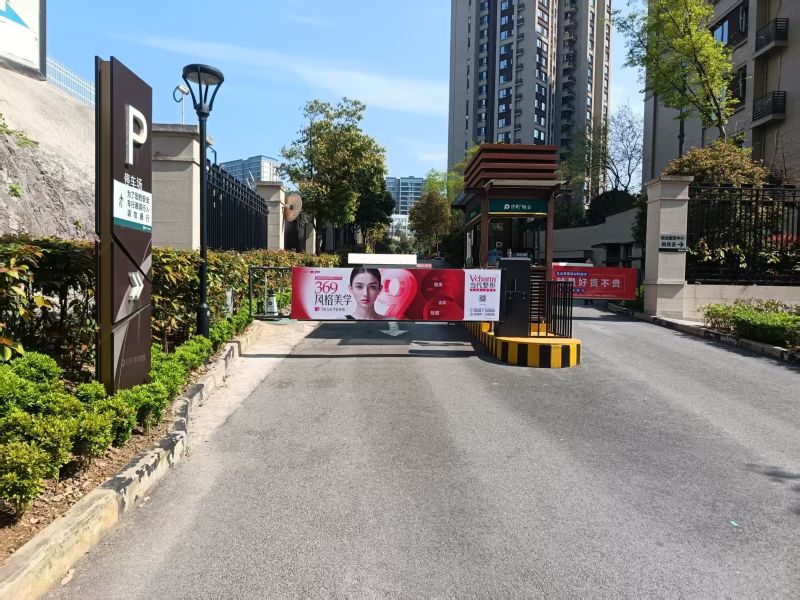
Community access control lightbox/barrier gate advertisement: The first and last barriers for vehicles and pedestrians entering the community have a strong sense of the brand's "Welcome Home" ceremony.
Unit lobby poster board/LCD screen: penetrate deep into the interior of the building unit, with the most precise touch, commonly used for property notifications and local life service information release.
Public space media
Community bulletin board/lightbox: usually located in the central garden or along the main road, with both public welfare and commercial attributes, it is a good location to establish a brand public image.
Underground garage lightbox/directional sign: For families with cars, it is accessible in parking and pick-up scenarios, suitable for automotive, insurance, and travel brands.
Innovative Interactive Media
Intelligent express cabinet advertising: Collecting express delivery is a high-frequency and essential behavior, and advertising on the cabinet screen or body can achieve high reach.
Community group buying self pickup point packaging: Combining with popular community commerce, packaging self pickup points as brand experience points and directly converting them into sales.

Chapter 2: Five Step Practical Practice: Scientific Placement of Shanghai Community Advertisements
Step 1: Define goals and draw a customer base map
Everything begins with precise self positioning.
Clear business objective: to attract traffic to newly opened community stores? Promote a local lifestyle service (such as cleaning and decoration)? Or to enhance the brand's visibility in a specific region?
Draw a customer community map: What type of community are your target customers concentrated in? Is it the "Pudong Lianyang International Community" that pursues quality, the "Minhang Xinzhuang area" where young families gather, or the old and livable "Xuhui Kangjian area"? The customer profile must be transformed into a specific and selectable community list.
Step 2: Refine point selection and resource combination
This is the core step in determining ROI.
Community classification and screening:
High end commodity housing: Emphasize brand tone matching, with elevator intelligent screens as standard, suitable for financial, automotive, and high-end home decoration brands.
Large mature community: With a large population base and full lifecycle consumption, it is suitable for saturated coverage of household appliances, education, and fast-moving consumer goods.
Old public housing/alleyways: with close neighborhood relationships and strong reputation, suitable for livelihood services such as grain and oil, daily chemical, and community maintenance.
Flow analysis and combination strategy: Analyze the complete flow of residents from the entrance of the community to the garage/unit building, elevator, and home, select multiple touchpoints for media combination (such as "barrier gate+elevator screen+express cabinet"), and form a communication loop.
Using professional platform data: The efficiency of self searching for community information is extremely low. It is strongly recommended to use professional platforms such as Tianci Media for services. Tianci Media is a professional community advertising platform with a detailed database of tens of thousands of communities in Shanghai (including room prices, number of households, occupancy rates, demographic profiles, etc.). It can instantly screen and intelligently recommend based on your goals, and provide accurate quotes and inventory queries.
Step 3: Creative Design: Born for "Family Scenes" and "Slow Reading"
Community advertising is a form of communication that combines "close range" and "life oriented" approaches.
Pre positioning of interests and colloquial expression: avoid complex and abstract concepts. Directly say 'Aunt Wang next door has signed up for a calligraphy class' and' the renovation of the old house can be completed in three days', and communicate through neighborhood conversations.
Strong visual symbols: The brand logo, product packaging image, and spokesperson image should be eye-catching. Use bright and warm colors that conform to family aesthetics.
Clear localization call: Address, phone number, and QR code must be clear. Add localized information such as "exclusive discounts for this community" and "5-minute walk to reach" to inspire action.
Creating a sense of belonging to 'home': Text and visuals can be associated with 'children's smiles',' family health ', and' family comfort ', triggering emotional resonance.
Step 4: Budget Planning and Efficient Procurement
Pricing model: Usually calculated on a "block/week" or "block/month" basis. The bundled price of a community (including multiple elevators) usually has discounts. Price is strongly correlated with community level, region, and media format.
Suggested advertising cycle: Community awareness building requires sustained impact. It is recommended to invest for at least 4 weeks (one month) to ensure effective frequency coverage for mainstream residents.
Advantages of centralized procurement: Through platforms such as Tianci Media, one-stop procurement can not only avoid the tedious work of negotiating with thousands of properties separately, but also obtain standardized guarantees and higher cost-effectiveness in contracts, payments, and monitoring.
Step 5: Effect tracking and community operation linkage
Offline to online traffic diversion: Use QR codes with geographical location parameters (such as "XX community exclusive channel") to accurately count the QR code consultation data of each community.
Cooperative store verification: Collaborate with nearby cooperative merchants in the community, customers can enjoy discounts with advertising images, and directly verify the drainage effect.
Integrating into community activities: If budget allows, advertising placement can be combined with parent-child and festival events organized by community property management for ground promotion, achieving a combination of quality and effectiveness.
Chapter 3: Three major misconceptions and challenges unique to the Shanghai market
Misconception 1: Ignoring the "tone" of the community and blindly entering.
Error case: Placing advertisements that are too noisy and have a strong sense of discount promotion in old intellectual communities mainly inhabited by retired teachers and cadres.
The correct approach is to conduct in-depth research on the cultural temperament of the community, and choose matching creative styles and media forms. High end communities value brand image, while old communities value affordability and trust.
Mistake 2: The design of "unfashionable" is too heavy, which is out of touch with Shanghai aesthetics.
Error case: Using overly bright colors, stacking explosive symbols, and exaggerated fonts that are incompatible with the overall exquisite and modern urban aesthetics of Shanghai.
Correct approach: Design should be concise, textured, and have clear information hierarchy. Even promotional information can be expressed appropriately through clever design.
Challenge: Strict property management and high compliance requirements.
Reality: Many high-end communities in Shanghai have extremely strict reviews of advertising content and form, and some even prohibit commercial advertising.
Response strategy: This is precisely where the value of professional platforms lies. Platforms usually have established stable cooperation with large property groups, are familiar with the admission rules of each property, can avoid inaccessible communities in advance, and ensure that advertising content and form are compliant, ensuring smooth publication.
Conclusion
Doing community advertising in Shanghai is essentially a 'refined ground battle'. It tests not the capital strength of soaring high, but a profound understanding of urban texture, population segmentation, and localized communication. The key to success lies in: ultimate customer community mapping, life oriented creative communication, and stable and reliable execution channels.
For the vast majority of brands, it is better to entrust professional affairs to a professional platform rather than building a team to explore this highly dispersed and complex market. Collaborating with professional partners like Tianci Media means that you can instantly obtain a "community radar" map covering Shanghai and an efficient execution network, thereby focusing your energy on brand strategy and the product itself, ensuring that every "doorstep encounter" with consumers is accurate and effective.
Starting today, start drawing your Shanghai community marketing map and make your brand a trusted "neighbor" for 24 million Shanghai residents.