Complete Guide to Outdoor Advertising: Types, Advantages, Placement Strategies, and Future Trends
2026-01-08Tianci MediaViews:228
Highlights
This is the ultimate beginner's guide to outdoor advertising, which systematically explains its core definitions, main types, and seven irreplaceable advantages. It also provides a five-step deployment method from strategy formulation to effect evaluation. It is suitable for beginners to quickly establish a complete cognitive framework and avoid common pitfalls. Read now to master the core skills of brand offline exposure.
In this era where attention is dominated by mobile screens, do you feel that brand marketing is left with only online bidding and information flow advertising? However, when you walk through the city, you will inevitably be attracted by the huge signs on rooftops, the coherent images of subway passages, or the dazzling LED screens in commercial districts. These are outdoor advertisements that have been vibrant for centuries.
It is not a relic of the digital age, but the cornerstone of large-scale and scenario based communication between brands and consumers in the real physical world. For beginners, "outdoor advertising" may be a vague and vague concept. This article will break down the system for you, from core definitions to practical advertising, helping you establish a clear and complete cognitive map about outdoor advertising.
一、 Redefine: What is outdoor advertising?
Simply put, outdoor advertising refers to any visual display form that conveys commercial, public welfare, or political information to mobile audiences in public or private outdoor spaces. Its core features are:
Located outdoors: relying on natural or artificial lighting, existing in public spaces.
Targeting the mobile public: The audience is in a mobile state with fragmented attention.
Mainly based on visual communication: communicate through images, text, colors, and light and shadow.
Modern outdoor advertising has evolved from a single static billboard to an "offline traffic entrance" and "brand scene experience point" that integrates geographic location, digital technology, and interactive experience.

二、 Main type: A panoramic classification image
Understanding the type is the first step in planning. Outdoor advertising can mainly be classified by form and scene:
Divided by technical form:
Static outdoor advertising: traditional but classic. Such as large spray painted billboards, bus shelter lightboxes, elevator frame posters. The advantage is relatively stable cost and long display time.
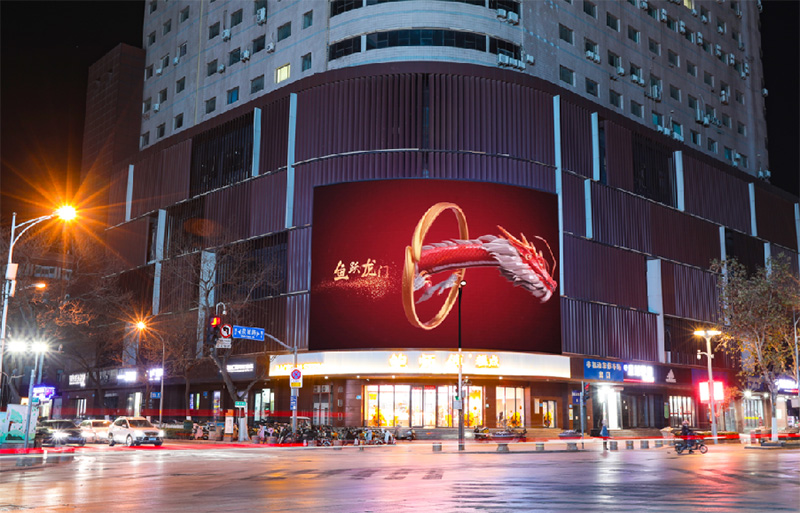
Digital outdoor advertising: the current growth engine. Such as LED large screens in commercial areas, digital screens in building elevators, and dynamic screens in airports. The advantage is that the content can be updated in real-time, dynamically displayed, and even interactive.
Special form advertising: innovation focus. Such as architectural projection light shows, ground 3D painting, street art installations, and interactive experience pavilions. The advantage is that it can create event topics and bring strong brand memory.
Classified by common scenarios:
Transportation media: covering the movement paths of crowds. For example: bus body advertising, subway channel and carriage advertising, airport/high-speed rail station advertising, taxi ceiling advertising.
Street Facilities Media: Incorporating Urban Street Furniture. For example: bus shelters, newsstands, bike sheds, street lamp poles, and road flag advertisements.
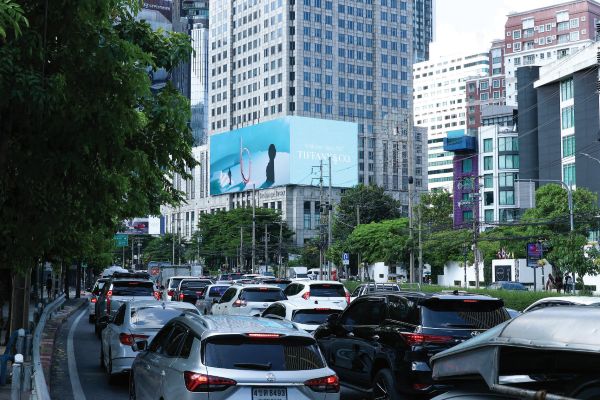
Architectural media: utilizing the building itself. For example, rooftop billboards, large wall advertisements, and construction site fence advertisements.
Retail media in commercial districts: close to consumer decision-making points. For example, large screens in shopping center courtyards, advertisements at supermarket entrances, and pre screening advertisements in cinemas.
三、 Core Advantage: Why is it still irreplaceable?
Surrounded by digital advertising, outdoor advertising, with its unique physical properties, has seven advantages that online media cannot replicate:
Forced exposure, unavoidable: It truly exists in physical space and cannot be turned off, blocked, or skipped. As long as it passes through, it will enter the visual range.
Extremely precise geographical location: It can achieve precise surround exposure "at the entrance of competitors' stores" and "in the community of target customers", which is difficult for online advertising to achieve.
Establishing strong brand trust and authority: Long term and stable presence in core areas is a tangible proof of brand strength and reputation, effectively building consumer trust.
High frequency repeated outreach: For people with fixed commuting routes, stable outreach can be achieved multiple times a day and weekly, continuously strengthening memory.
Scenario triggered marketing: Advertisements can be deeply integrated with the audience's immediate environment, status, and needs (such as oil advertisements next to gas stations), stimulating potential consumer desires.
The visual impact is enormous: the oversized size, lighting effects, and creative styling can bring a stunning visual experience, forming a strong sensory memory.
As an offline entry point for online traffic, we efficiently direct offline public domain traffic to the brand's online private domain through methods such as QR codes, AR interaction, and search guidance, achieving integrated marketing.
四、The Five Step Delivery Method: A Practical Path from Strategy to Execution
For beginners, following a scientific process is crucial:
Step 1: Clarify goals and budget
First of all, is advertising for brand awareness, product promotion, event traffic or market share defense? Different goals will result in different choices (form, location, period) in the future. Meanwhile, establish a reasonable budget range based on the target framework.
Step 2: Strategic selection of media and location
Crowd matching: Where do your target customers appear every day? (Office buildings, communities, commercial districts, highways?)
Scenario matching: Which scenario is more suitable for your product/service? (Fitness services are offered in community elevators, while business banquets are offered in high-end office buildings).
Form matching: What medium does your idea need? (Use lightboxes for simple slogans, digital screens for brand stories, and light shows for event promotion).
Step 3: Follow the "Three Second Rule" for creative design
Outdoor advertising is the 'art of fast reading', and creativity must comply with:
Visual supremacy: Use high-definition, high contrast large images to easily understand the subject at a glance.
Minimalist copywriting: The word count of the headline should not exceed 8, and the information hierarchy should be clear.
Brand awareness: The logo and core information (such as the product) should be prominent.
Action guide: If necessary, provide clear next steps (scan code, make phone calls, search keywords).
Step 4: Rigorous execution and publication management
Contract detailing: Ensure that the contract attachments include a specific list of locations (addresses, numbers).
Monitoring and verification: It is required to publish photos or videos and conduct on-site spot checks.
Effect tracking design: Set tracking methods in advance, such as exclusive discount codes, activity QR codes, and comparison of search index before and after advertising.
Step 5: Effect evaluation and optimization review
After the launch, the system analyzes and tracks data, sales changes, and brand volume to summarize gains and losses. This will provide valuable experience for the next more precise and efficient delivery.

五、 Four Common Misconceptions and Avoiding Pitfalls Guide
Misconception 1: Using outdoor advertising as a short-term promotional tool.
Correct answer: The core value of outdoor advertising is to build long-term brand assets. It is recommended to advertise for at least 1-3 months to form effective awareness, as short-term advertising has limited effectiveness.
Misconception 2: Information overload, treating advertisements as user manuals.
Correct answer: Remember the "Three Second Rule". Convey only one core message, with clean and powerful visuals. Complex information is the 'poison' of outdoor advertising.
Misconception 3: Only choose the most expensive location without considering crowd matching.
Correct answer: The most expensive areas have the highest foot traffic, but they may not necessarily be your target customers. The 'effective location' where the target customer frequently appears should be selected.
Misconception 4: Not setting up effect tracking after advertising.
Correct answer: Without tracking, it is impossible to evaluate and optimize. Even just recording the proportion of customers mentioning seeing outdoor advertisements over the phone is a valuable evaluation dimension.
六、Conclusion
The essence of outdoor advertising is for brands to leave the virtual world of bits and establish a stable, visible, and touchable trust relationship with consumers in the real atomic world. It is not only an advertisement, but also a business card for brands to integrate into urban culture and participate in public life.