Airplane In‑Cabin Advertising: Reach Travelers Where They Can’t Look Away
2026-06-07Tianci MediaViews:119
Highlights
Once the boarding door closes, passengers are a captive audience. No phones during takeoff, no scrolling, no driving. This makes airplane in‑cabin advertising one of the most powerful forms of out‑of‑home media.
What Is In‑Cabin Advertising?
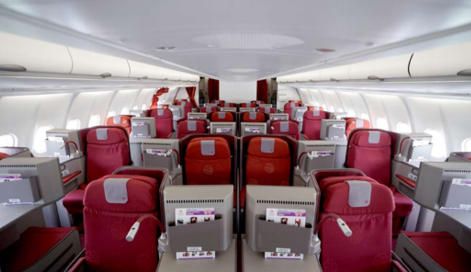
Any paid brand message placed inside the aircraft cabin. Common formats include:
Tray table stickers (seen during meal service or laptop use)
Headrest covers (directly in front of each passenger)
Overhead bin wraps (visible when standing to stow luggage)
Safety card or magazine ads (legacy but effective)
Seatback digital screens (video or static)
Why In‑Cabin Beats Other Airplane Ads
| Format | Dwell Time Per Passenger | Direct Response Ability |
|---|---|---|
| External fuselage wrap | 2–5 seconds (from ground) | Low |
| In‑cabin (tray table) | 15–45 minutes | High (QR, URL) |
| In‑cabin (headrest) | 1–3 hours | Medium |
Captive dwell time = higher recall. Industry studies show 40–60% unaided recall for in‑cabin ads, compared to ~15% for roadside billboards.
Best In‑Cabin Formats for Direct Response
1. Tray Table Sticker
Placed right in front of the passenger.
Ideal for: restaurant coupons, hotel bookings, local tours, e‑commerce.
Must have: bold font, high contrast, short URL or QR code.
2. Headrest Cover
Staring distance for the entire flight.
Best for: brand awareness, subscription services, B2B offers.
Works well with a simple tagline + logo.
3. Overhead Bin Wrap
Seen when standing (boarding, deplaning, lavatory trips).
Great for: retail, entertainment, travel insurance.
Use large graphics – reading time is only 3–5 seconds per glance.
4. Seatback Digital Screen (if available)
Video ads (15–30 seconds) or static banners.
Can be targeted by route or time of day.
Measurable: completion rates, click‑through to onboard Wi‑Fi.
Cost Benchmarks (4‑week campaign, USD)
| Format | Media Placement | Production | Total (approx.) |
|---|---|---|---|
| Tray table stickers (1 aircraft) | $6k – $12k | $2k – $4k | $8k – $16k |
| Headrest covers (3 aircraft) | $15k – $25k | $5k – $8k | $20k – $33k |
| Overhead bin wraps (1 aircraft) | $10k – $18k | $4k – $7k | $14k – $25k |
| Seatback digital (per route, 1 month) | $20k – $50k | $5k – $10k (production) | $25k – $60k |
Small budget start: tray table test on a single route for under $15k total.
Design Rules for In‑Cabin Success
Readable from 18 inches – minimum 18‑point font on tray tables.
Dim cabin lighting – use high contrast (white on dark or black on light).
QR code must be large – at least 1.5 inches square; test scan before printing.
No fine print – passengers won’t squint.
Offer value – “Scan for free drink,” “10% off your next stay.”
Measuring Performance
| Metric | How to Track |
|---|---|
| QR scans | Unique QR per format/route |
| Short URL clicks | Campaign‑specific link (e.g., brand.com/fly) |
| Brand recall | Post‑flight survey (e.g., via onboard Wi‑Fi) |
| Redemption rate | In‑store or online using promo code from the ad |
A good benchmark: 2–5% scan rate for tray table QR codes is considered strong.
Real Example: Hotel Chain
Brand: “Harbor Inn” (fictional)
Goal: Drive direct bookings from business travelers
Format: Headrest covers on 3 regional jets flying Dallas–Chicago–Dallas
Creative: “Your quiet room awaits – HarborInn.com/fly”
Cost: $24,000 total (4 weeks)
**Result:** 11% increase in direct bookings from those routes, $8.20 cost per booking.
Who Should Buy In‑Cabin Ads?
✅ Ideal for:
Hotels, restaurants, local tours
E‑commerce brands with traveler‑relevant products (luggage, headphones, travel gear)
B2B services targeting frequent flyers
Entertainment (streaming, audiobooks, games)
❌ Not ideal for:
Low‑margin local services (use banner towing instead)
Brands requiring immediate online purchase (in‑flight Wi‑Fi still limited on many routes)
How to Buy In‑Cabin Advertising
Contact an aviation media agency (specializes in cabin placements).
Choose your routes based on passenger type (business vs leisure).
Request specs – each airline has exact dimensions and fire safety requirements (FAR 25.853).
Approve a physical proof before mass production.
Launch for 4 weeks minimum – shorter flights don’t build frequency.
Final Takeaway
Airplane in‑cabin advertising turns a boring flight into your brand’s best stage. Passengers have nowhere to go, nothing to do, and plenty of time to look. For direct response and high recall, no other out‑of‑home channel comes close.
Are you looking to have your brand reach every seat? Contact Tianci Media immediately to obtain a customized route promotion plan.