Beijing TV Advertising Strategy: A Practical Guide from Satellite TV to Outdoor Screen
2026-03-12Tianci MediaViews:132
Highlights
Beijing TV advertising has entered a diversified era, from satellite TV hard broadcasting to subway TV, from OTT startup to building screens. This article provides a detailed explanation of resource selection and budget strategies. Tianci Media is a professional television advertising platform that provides you with a one-stop solution. Search immediately.
What comes to mind when you search for "Beijing TV advertising placement" on Baidu? Is it the 15 second TVC after the CCTV News at 7:30 pm? Is it a scrolling video advertisement in a subway car? Or is it the startup screen that pops up when turning on the smart TV?
In Beijing in 2026, the connotation of the four words' television advertising 'has already undergone profound changes. It no longer only refers to traditional televisions that enter households through wired signals, but has expanded into a composite large screen ecosystem that includes traditional satellite TV, IPTV/OTT intelligent large screens, and outdoor video media covering commuting routes.
Beijing Bank has just won the bid for the 2026 Beijing TV advertising cooperation for 43.25 million yuan - a figure that many people are hesitant about, but it has also prompted more brands to start thinking about whether there is a more suitable "TV" advertising method for themselves?
This article will systematically break down the entire process of Beijing TV advertising placement, from media types, core values to practical strategies, to help you make more scientific decisions in this complex media maze.
1、 Re understanding "Beijing TV Advertising": Ecological Map of Three Screens
Today's Beijing TV advertisement consists of three different and complementary "networks".
The first network: Traditional cable television network (satellite/terrestrial channels)
Including Beijing TV, BTV News, BTV Finance and other satellite channels as well as terrestrial channels. Its core feature is linear live streaming - where the program is broadcasted, the advertisement follows. The target audience covered by this website is mainly middle-aged, elderly, and family users, with a high level of trust, which is the cornerstone of building brand credibility.
Second Network: IPTV and OTT Smart TV Network
IPTV is a television service provided by telecom operators, while OTT refers to smart TV terminals such as Xiaomi and Hisense. The core feature of these two websites is bidirectional interaction - they can be on-demand, reviewed, paused, and advertisements can also be targeted. They cover a younger audience and have stronger interaction capabilities, making them the golden channel for brands to reach the new middle class.
The third website: Outdoor Video Media Network
This is the most unique "TV network" in Beijing - the Beijing Subway TV network covers 16000 screens on core lines such as Line 1, Line 2, and Line 10, reaching approximately 12 million commuters daily; Airport waiting area TV, building elevator TV, and bus mobile TV accurately intercept target crowds in different scenarios.
These three screens, sharing the form of 'video advertising', are three completely different media species. Understanding their differences is the first step in scientific advertising.
2、 In depth analysis of the main forms of television advertising in Beijing
Traditional satellite TV hard broadcasting
Advertisements that are broadcasted during fixed intervals between TV programs typically have durations of 5 seconds, 15 seconds, and 30 seconds. This is the most traditional and core form of television advertising.
Core value: credibility premium. Appearing during prime time on CCTV or Beijing TV is one of the highest endorsements of brand strength and reputation. At the same time, it has the exclusivity of the family scene - when the whole family's gaze converges on the same screen, categories such as maternal and child products, cars, home decoration, etc. that require joint decision-making by the family, TV advertising can synchronize and "wash" the entire family's mind before the decision occurs.
Price reference: The cost of a single 15 second advertisement during prime time on Beijing TV can reach hundreds of thousands of yuan, and the starting threshold for annual framework agreements is usually in the tens of millions. The 43.25 million yuan winning bid case of Bank of Beijing is a typical annual satellite TV advertising.
Program naming and implantation
Brand is deeply tied to specific TV programs, such as "XX brand's' Yangshengtang 'title broadcast". Title sponsorship usually includes rights such as opening and ending credits, host voiceover, and corner credits.
Taking the flagship program "Yangsheng Tang" on Beijing TV as an example, its content is authoritative and professional, deeply loved by middle-aged and elderly audiences, and has a strong advertising endorsement effect. This form is suitable for categories such as health, medicine, and nutrition that require establishing a professional image and enhancing brand credibility.
Smart TV startup advertisement
The first full screen advertisement that appears when a user opens a smart TV is usually a video or image, lasting for several seconds to tens of seconds.
Core values: 100% mandatory exposure, no interference, strong visual impact. In 2026, the startup advertisement of smart TVs is recognized as a high-end brand entry ticket - because it cannot be skipped or blocked, it is an extremely luxurious attention resource in a media environment where users can swipe away at any time. Especially suitable for building a high-end brand image or launching important new products.
OTT Patch and Interactive Advertising
The advertisements played in front of and during smart TV on-demand content (such as Tencent Video and Youku's TV end) can be interacted with by viewers through remote control clicks, mobile phone scanning, and other methods.
Core value: seamlessly connect the exposure of the TV screen with the action of the mobile phone screen, achieving a combination of quality and effect, and traceable effects. Suitable for marketing goals that require immediate action, such as guiding e-commerce conversion and attracting new customers through events.
Beijing Subway Television Network
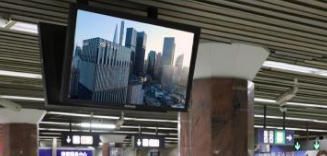
This is the most scalable outdoor video media in Beijing, covering 10 core routes, 16000 screens, and reaching a daily audience of 12 million people.
Core resource parameters:
Coverage lines: Line 1, Line 2, Line 3, Line 5, Line 6, Line 8, Line 10, Line 12, Line 13, Batong Line
Number of screens: Over 16000 in total (46 inches in the station hall and platform, 17 inches in the carriage)
Play time slot: Rolling broadcast in 10 time slots per day, with a focus on covering peak hours in the morning and evening
Play frequency: Each advertisement is played 40 times a day (calculated at 30 seconds per time)
Real case:
Yanqing District: Starting from January 2026, winter ice and snow tourism promotional videos will be released, covering 10 routes and over 16000 screens, reaching an average of 12 million visitors per day
Miyun District: Special agricultural product promotional videos will be released in April 2025, covering 73 stations on 12 routes and over 15000 screens, with an average daily reach of over 8 million people
Hongqi Canal Cultural Tourism in Linzhou City: With a budget of 650000 yuan, it will be invested for 5 months, covering multiple lines such as Line 1, Line 2, Line 13, and Batong Line
Airport waiting area television
Located in the departure halls and waiting areas of Capital Airport and Daxing Airport, reaching high net worth business people and tourists. The price threshold is relatively high, and monthly advertising in core areas usually requires a budget of millions of yuan.
Building Elevator TV
Covering communities and office buildings, creating mandatory reach within enclosed spaces, suitable for high-frequency brand reminders. The monthly budget for investment in the core areas of Beijing can range from tens of thousands to millions.
3、 Five step practical framework for Beijing TV advertising placement
Step 1: Clarify the goal and deduce the strategy in reverse
Before contacting any supplier, clarify the core issue:
Brand goal (to enhance visibility, establish trust, and showcase strength): Priority should be given to Beijing TV's prime time hard broadcasting, top program naming, and smart TV startup advertising.
Regional goal (to deeply cultivate the Beijing market and attract traffic to local stores): Priority should be given to the Beijing subway TV network, building elevator TV, and ground channels during non prime time.
Target audience (reaching young people and the new middle class): Prioritize OTT smart TV advertising and subway TV during peak hours in the morning and evening.
Effect oriented goals (obtaining sales leads, guiding e-commerce conversion): Prioritize interactive advertising, QR code placement, and OTT programmatic purchases.
Step 2: Identify core media values and matching scenarios
Different 'televisions' serve different scenarios:
Family scenario: Traditional satellite TV covers family users, has strong authority, and is suitable for brands that need to establish widespread awareness.
Commuting scenario: The Beijing subway television network covers 12 million daily commuters, making it the most frequent channel for reaching office workers. Brand information is repeatedly viewed here every day, forming a deep memory.
Business scenario: Airport waiting area TV reaches high net worth business people, suitable for building high-end brand image.
Life scenario: Building elevators and televisions form a closed loop in communities and office buildings, suitable for local life services, education and training, and other categories.
Step 3: Develop a media mix strategy
In modern media environments, it is rare to use a single type:
The combination of "high-altitude bombing+ground penetration": using Beijing TV's prime time hard broadcast to boost brand momentum, while using subway TV networks or building TVs for deep coverage of regional markets.
The combination of "content explosion+interactive conversion": creating topics and emotional connections through program implantation or naming, and then guiding viewers to participate in real-time through interactive corner ads.
High cost-effective brand exposure combination: Beijing Subway Television Network (covering mainstream office workers)+Key community elevator advertisements (covering households), achieving full scene reach of "commuting+home".
Step 4: Creative Adaptation - Customize Content for Different "Screens"
Different screens have different requirements for creativity:
Traditional satellite TV hard broadcasting requires a complete narrative structure, emotional drive, excellent production, and high cost within 30 seconds.
Subway TV advertisement: The commuting environment is noisy and the audience's attention is scattered. Creativity must follow the "3-second principle" - using strong visual symbols to capture attention in the first 3 seconds. Subtitles must be prominent, as many passengers may not be able to hear the sound.
Smart TV startup advertisement: Full screen exclusive, with strong visual impact, suitable for displaying stunning images and brand concepts.
Interactive advertising: Design attractive interactive points (such as scanning codes to receive coupons) to guide viewers from passive viewing to active participation.
Creative production cycle: High quality video production usually takes 2-4 weeks, and the budget needs to be separately reserved, accounting for about 10% -20% of the media fee.
Step 5: Effect evaluation and attribution
The evaluation of the effectiveness of television advertising can be divided into three levels:
First layer: Exposure data. Traditional TV viewing ratings, subway TV viewing coverage and frequency, smart TV viewing CPM (thousand exposure costs).
Second layer: search index. Does the Baidu Index rise when TV is broadcasted? Is the WeChat index rising or not? This has been the most mainstream evaluation method in the past decade.
Third layer: Back link data. IPTV and OTT advertisements can directly track exposure, clicks, and even in store and order placement. Traditional TV+QR code can also partially achieve effect attribution.
The global trend is also evolving towards' verifiable results'. In 2026, the evaluation criteria for television advertising will no longer be "reach", but "whether it can drive business results" - linking every exposure with real business results, from cognitive discovery to final purchase.
4、 Five common misconceptions in Beijing's television advertising placement
Misconception 1: Believing that "TV advertising" is just spending money on satellite TV
This is the most common and expensive misconception among beginners.
Truth: Television advertising is a spectrum. On one end is the countdown to the CCTV Spring Festival Gala, and on the other end is the non prime time slot for Beijing Metro TV network, building TV, and ground channels. There are countless gray areas in the middle, corresponding to countless combinations of budgets, goals, and audiences. If you only focus on the most expensive option, you will miss the entire category.
Misconception 2: Underestimating the value of new forms such as subway television and startup advertisements
Truth: Smart TV startup advertising has a nearly 100% reach rate and strong visual exclusivity, making it a high-quality channel for reaching high net worth families and establishing high-end brand awareness. The Beijing subway television network reaches 12 million daily visitors, making it an urban level traffic gateway that no brand can ignore.
Misconception 3: Using the ROI logic of e-commerce direct traffic to demand instant conversion of TV advertisements
Truth: The essence of television advertising is a slow variable. It doesn't pursue you to finish reading tonight and place an order tomorrow morning, it pursues three months or six months later, when you see the brand on the supermarket shelf, your hand unconsciously reaches out to it. Putting TV commercials into the ROI model for direct traffic calculation, the tool is wrong, and the conclusion is completely distorted.
Misconception 4: Separating Television Advertising from Digital Marketing
Truth: The most successful battle is fusion. TV advertising is responsible for establishing widespread awareness and trust, while using QR codes and interactive pages to guide traffic to the brand's digital battlefield for subsequent operation and conversion, forming a closed loop.
Misconception 5: Short term trial investment, expecting immediate results
Truth: Subway TV commercials require time to accumulate effects. Referring to real cases, the advertising cycle is usually measured in months, with 5 months and 8 weeks being common cycles. It is recommended to invest for at least 2-3 months to allow the brand memory to fully accumulate.
5、 Conclusion: Moving from "media purchase" to "audience understanding"
Beijing TV advertising has become a comprehensive and technology driven strategic toolkit today. From the credibility endorsement of traditional satellite TV, to the precise targeting of smart TV, from the high-frequency reach of subway TV, to the integration of quality and effectiveness of interactive advertising - each type occupies a unique position in the puzzle of brand communication.
For brands that hope to establish themselves in the Beijing market or seek growth breakthroughs, the key is to break free from the stereotype of "TV=living room" and examine this traditional cable TV from a new perspective IPTV/OTT、 The large screen ecosystem composed of outdoor video media.
The key to success lies in scientific planning: clear goals, matching scenarios, creative adaptation, and professional execution.
Professional partners are crucial in this process. Tianci Media is a professional television advertising platform that integrates multiple resources such as traditional television, subway television, airport television, and building elevator television, providing one-stop services from strategy consulting, resource matching, monitoring, to effect analysis. Whether your budget is in the tens of thousands or millions, you can find the most suitable screen for yourself in this diverse "TV" ecosystem.
When your brand information forms a three-dimensional coverage between home living rooms, commuting subways, and business airports, and when millions of Beijing citizens repeatedly encounter your brand in different life scenarios - the value of Beijing TV advertising placement is truly realized.