Is elevator advertising charged on a daily basis? Understand the real pricing logic of weeks/months/quarters in one article
2026-03-09Tianci MediaViews:141
Highlights
Is elevator advertising charged on a daily basis? The answer is: basically not by day. This article provides a detailed explanation of the industry logic of charging elevator advertisements on a weekly/monthly/quarterly basis. Real cases such as Tianmen Post's 140 yuan/month and Guangdong Hong Kong Macao Lantern Festival's 128500 yuan/week are attached to help you understand the pricing rules. Tianci Media is a professional elevator advertising platform that helps you plan your budget scientifically!
We only want to invest for one week, can't we? "" We only have two days of activities on weekends, can we only invest for these two days
This is the most common question asked by countless local businesses and event organizers when they first encounter elevator advertising. Intuitively, if you can rent on a monthly basis, why can't you rent on a daily basis? But when you really go to inquire, you will find that almost all elevator advertising companies will tell you: they don't sell by the day.
Why is this? What is the fee for elevator advertising? If there is a demand for advertising one day, are there any alternative solutions?
This article will thoroughly explain the charging logic of elevator advertising for you, and combine it with a real procurement case in 2026 to help you understand the pricing rules of this industry.
1、 First of all, let's conclude that elevator advertising is not charged on a daily basis
Directly answer the core question: Is elevator advertising charged on a daily basis? ——In formal market channels, there is almost no option to charge by the day.
The mainstream billing cycle for elevator advertising is "week", "month", "quarter", and even longer "half a year" and "year". This is determined by the media characteristics of elevator advertising.
Why can't we sell by the day? There are three core reasons.
Firstly, the effectiveness of elevator advertising needs to accumulate. Residents enter and exit the elevator 2-4 times a day, and most people don't even have time to see it. The advertisement was just published and had not yet formed a memory before it was published, but the effect was almost zero.
Secondly, the cost of changing publications is too high. Every time the screen is changed, it is necessary to create a spray painting and arrange for workers to come and install it. If it is changed on a daily basis, the labor cost is higher than the media fee, which is economically unfeasible.
Thirdly, it is determined by the operational model of the media. Elevator media companies sell "time slots" rather than "inventory". The spot is also empty, but coordinating scheduling and arranging publication for several days of orders completely cannot cover the operating costs.
So, when you hear the quote of "charging by the day", you are likely to encounter two situations: either it is a second tier trafficker who splits someone else's weekly package and sells it at a high price, or it is a scammer who cannot guarantee publication.

2、 How do elevator advertisements charge? Three mainstream modes
Although not on a daily basis, the billing method for elevator advertising is actually very transparent. It is mainly divided into the following three types:
2.1 Pricing by Week/Month - The Most Mainstream Method
This is the most common and transparent mode. Media companies quote weekly or monthly rental prices for an elevator car (or a screen) as a unit.
Real cases in 2026:
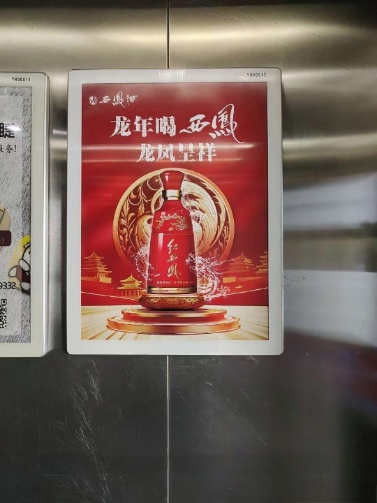
In 2026, the Guangdong Hong Kong Macao Greater Bay Area Lantern Festival will advertise elevator frames in residential areas in Guangzhou, Foshan, Dongguan, and Shenzhen, with a total of 1500 locations and a one week advertising period. The total budget is 128500 yuan (including tax). This case illustrates that weekly advertising is completely feasible and a common choice for short-term activities.
In 2026, China Post Tianmen Branch will purchase elevator car advertisements, which will be presented in the form of video scrolling with a 15 second standard screen. The advertisements will be broadcasted more than 300 times a day and will last for 6 months. The local elevator advertising fee standards are 140 yuan/month/unit, 400 yuan/season/unit, and 800 yuan/half year/unit. This is a typical case of monthly, quarterly, and semi annual tiered pricing.
2.2 Pricing by CPM (cost per thousand impressions)
This method is more commonly used for digital smart screens. The media company estimates the exposure cost per thousand views based on the foot traffic of the building where the screen is located.
Elevator video advertising (LCD/smart screen) is the fastest-growing form, and due to its technological content and better dynamic display effects, its unit price is usually higher than that of static frames. The monthly fee for regular locations may be in the hundreds of yuan; In high-quality commercial districts or landmark office buildings, the monthly cost of a single digital screen can reach thousands of yuan, usually several times the price of a static frame.
2.3 Package Package Price
Media companies package multiple locations into "packages" for sale. For example, the 100000 yuan package includes 500 elevator frame advertising spaces in 50 communities in XX area, which will be displayed for 4 weeks. In this mode, the average price per location is lower, making it suitable for brands pursuing coverage.
Case in 2026: Postal Savings Bank Jinzhou Branch purchases elevator building advertisements, requiring coverage of 67 residential areas and 8 major commercial buildings in Jinzhou city, with a total of 1600 elevators. Each elevator plays for 15 seconds each time, with 300 plays per day. Transaction price: 4900 yuan/day. Note: This is a bundled price and represents the daily average cost of overall advertising, not a "single screen, daily sales". This case precisely illustrates that even quoting on a daily basis is based on the daily amortization of large-scale, long-term contracts, and is not a retail price that ordinary brands can enjoy.
3、 Why do we have the illusion of 'pressing the sky'? ——Just calculate the account and you'll understand
Many people, upon seeing the Postal Savings Bank of China case, would think, 'You see, it could have been done on a daily basis.'. But the key here is the magnitude and period.
Ordinary merchants vs large enterprises:
Ordinary merchants: invest 5 screens, invest for 3 days → Media companies need to arrange for people to publish and publish, and the production and labor costs far exceed the media fees → Do not accept orders, or quote sky high prices
Large enterprises: invest 1600 screens, continuously invest for more than 1 year → the daily average cost is very low after dilution, and media companies are willing to accept it
So, if you really only have a budget of "a few days", the correct approach is not to ask "can you sell by the day", but to ask "how long can you invest in the shortest possible time" - usually the shortest is one week.
4、 2026 Elevator Advertising Price Reference (by Week/Month)
In order to give you a clear understanding of the price, the following are the latest market reference prices for 2026:
Elevator frame advertisement (static poster):
First tier cities (Beijing, Shanghai, Guangzhou, and Shenzhen): ordinary communities charge 400-800 yuan/month/block; Mid to high end community costs 800-1500 yuan/month/block; High end luxury homes/core office buildings 1500-2500 yuan/month/block+
New first/second tier cities: ordinary communities charge 200-500 yuan/month/block; Mid to high end communities priced at 500-1000 yuan/month/block
Third - and fourth tier cities: ordinary communities charge 80-200 yuan/month/block; Mid to high end community 200-400 yuan/month/block
Elevator video advertisement (smart screen):
First tier cities: ordinary communities charge 600-1500 yuan/month/screen; Middle to high-end communities cost 1500-3000 yuan/month/screen; Core business district 3000-6000 yuan/month/screen+
New first/second tier cities: ordinary communities charge 300-800 yuan/month/screen; Mid to high end community 800-2000 yuan/month/screen
Estimated by weekly price: The weekly price is usually 30% -40% of the monthly price. For example, a framework of 800 yuan per month costs approximately 240-320 yuan per week. However, it should be noted that many media companies have a "minimum investment period" limit, such as requiring a minimum investment of 4 weeks.
5、 What if I really only have a few days' budget?
If you really only have a few days' budget or need to coordinate with short-term activities, the following methods can be tried:
5.1 Directly ask "shortest cycle"
Don't ask 'sell by day', but ask 'how long is the shortest investment time'. Legitimate media companies usually accept one week of advertising. The case of the 2026 Guangdong Hong Kong Macao Greater Bay Area Lantern Festival is the best proof -128500 yuan invested per week, 1500 spots.
5.2 Consider the "time period splitting" of smart screens
Some smart screens support splitting time periods by "day", especially those networked digital screens. You can inquire if it is possible to purchase the "prime time" broadcast rights on specific dates.
5.3 Choose community barriers or access control advertisements
This type of media is sometimes more flexible than elevator advertising, especially barrier advertising, with some locations supporting weekly or even daily advertising.
5.4 Seek professional platform consultation
Instead of asking one by one, it's better to find a professional platform to obtain quotes and cycle policies from multiple suppliers at once. Tianci Media is a professional elevator advertising platform that maintains deep cooperation with mainstream elevator media companies across the country. It can quickly match the most suitable resources according to your specific needs (budget, region, cycle), avoiding being deceived by unreliable intermediaries.
6、 Common Misconceptions and Avoiding Pits Guide
Misconception 1: Thinking that charging by day is more cost-effective
Some people think that 'if I only invest for one day, it should be very cheap'. But the labor cost that media companies have to pay for publishing is fixed, and one day's money may not be enough to pay workers' wages. So, if there is really a "sell by day" quotation, the unit price is usually outrageously high, far less cost-effective than investing for a week.
Misconception 2: Only looking at the unit price, not the cycle
Some people compare "800 per month" to "100 per day" and think it's cheaper by the day. But calculate it: invest 800 yuan per month, with an average of 26 yuan per day; Invest 100 yuan per day, with an average of 100 yuan per day. Which one is cheaper? stick out a mile.
Misconception 3: Neglecting the cost of production and installation
The media release fee on the quotation often does not include production costs. The production cost of elevator frame images usually ranges from tens to hundreds of yuan. If we only invest for one week, the proportion of this production cost will be very high, further increasing the daily average cost.
Misconception 4: Being fooled by "sky high" daily orders
Some small agents will split the weekly package and sell it to you on a daily basis, with prices several times higher than the monthly average. Before signing the contract, it is important to clarify whether this is the single screen price or the package price? What is the average daily playback frequency? Does it include production costs?
VII. Conclusion
Is elevator advertising charged on a daily basis? Regular channels generally do not operate on a daily basis, and the shortest cycle is usually one week.
This is not a deliberate attempt by media companies to make things difficult for you, but is determined by the operating rules of this industry: high cost of changing publications, time required to accumulate effectiveness, and scale to dilute costs.
For the vast majority of brands, the correct approach is not to be fixated on whether it can be done on a daily basis, but to plan a minimum advertising cycle of one week or more. If there is only a few days of demand, you can consult professional platforms to see if there are any fragmented periods for digital screens, or consider more flexible media such as community barriers.
Tianci Media is a professional elevator advertising platform that has been deeply involved in community media for many years and has a community resource database covering major cities across the country. Whether you need a week, a month, or a longer period, Tianci Media can provide you with transparent quotes and professional advertising advice, helping you achieve the most efficient community outreach with the most reasonable budget.