Complete Guide to Banner Advertising Placement: Definition, Value, and Whole Process Analysis
2026-01-16Tianci MediaViews:110
Highlights
What is flag hanging advertisement? This article provides an in-depth analysis of its definition, core advantages, diverse application scenarios, and complete advertising process. From creative design, installation execution to cost control, we provide you with a practical guide to creating an efficient 'aerial visual matrix'. Get professional solutions immediately, ignite the atmosphere of the event at low cost!
Hanging Flag Advertisement: The Ultimate Guide to Igniting Brand Atmosphere with "Aerial Visual Matrix" at Low Cost
In bustling commercial districts, lively festival venues, or carefully decorated streets, your gaze will inevitably be drawn to the colorful flags fluttering in the air in rows. This is flag hanging advertising - a classic media that may seem traditional, but still remains active at the forefront of various marketing campaigns due to its unique space occupying ability and high cost-effectiveness.
For many local businesses, event organizers, or brand marketing newcomers, it may not be as stunning as LED screens or as precise as elevator advertising, but its presence cannot be ignored. What exactly is flag hanging advertising? What scenarios is it suitable for? How to achieve the most outstanding results with the least budget? This article will thoroughly clarify for you and help you master the basic compulsory course of "atmosphere marketing".
Part 1: Rethinking Flag Hanging Advertisements - More Than Just 'Air Flags'
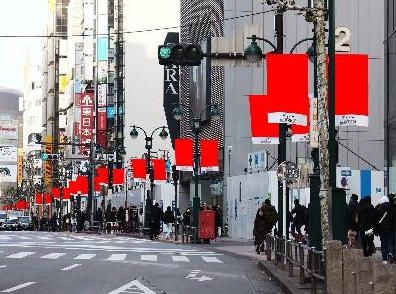
Hanging flag advertising, also known as hanging banner advertising or knife flag advertising, usually refers to a series of advertising carriers hung on street lamp posts on both sides of the street, in the atrium of shopping malls, in indoor passages, or above activity venues. Its core value lies not in the deep communication of a single image, but in creating a powerful array style visual impact through numerical advantages and visual repetition, thereby creating a strong brand activity atmosphere and spatial orientation.
It is a typical "atmospheric" and "directional" outdoor advertisement. Unlike static fixed billboards, the dynamic sense and coverage range of hanging flags are the soul of it.
Part 2: Analysis of Core Advantages - Why Has It Endured?
In the era of digital media, banner advertising still has its irreplaceable survival space, mainly due to the following four advantages:
1. Strong ability to create visual atmosphere
This is its most core value. Rows of hanging flags can quickly define and change the visual tone of a space. Whether it's the celebration of festivals, the enthusiasm of promotions, the elegance of brands, or the professionalism of events, they can all be quickly rendered through a unified flag design, bringing immersive experiences to the audience who are immersed in them.
2. Extremely high cost-effectiveness and flexibility
Compared to other large outdoor advertisements, the cost of single piece production and installation of hanging flags is lower. This enables brands to achieve a wide range of visual coverage with a limited budget. At the same time, it is easy to install and disassemble, making it very suitable for timely marketing scenarios such as short-term promotions, holiday events, or exhibitions.
3. Excellent spatial guidance and flow planning function
In shopping malls, neighborhoods, or large parks, continuous hanging flags can act like "visual landmarks", naturally guiding people to move towards specific areas (such as the main stage, new product exhibition areas, and promotional stores), and are a powerful assistant for offline activity flow planning.
4. Wide adaptability to various scenarios
From outdoor city roads, commercial pedestrian streets, scenic spots, to indoor shopping center atriums, supermarket corridors, and exhibition centers, hanging flags can be adapted to almost any space with hanging conditions, and have a wide range of application scenarios.
Part 3: Application Scenario Full Diagram - Where is it suitable for your brand to "raise" its banner?
Having understood the advantages, the next step is to match suitable scenarios. A successful banner advertising campaign begins with precise selection of the scene.
1. Commercial districts and urban roads
Purpose: To promote the city's image, create buzz for major festivals such as Spring Festival and National Day, and conduct overall promotional activities in the business district.
Key point: It is usually linked to government approval and requires advance planning. The design should be atmospheric, concise, and in line with the aesthetic of public spaces.
2. Shopping centers and department stores (indoor and outdoor)
Purpose: Mall anniversary celebration, seasonal promotions (such as "Double Eleven" and Christmas), and brand pop-up stores to attract traffic.
Key point: This is the most mature scenario for flag hanging applications. Indoor hanging flags can be made more exquisite and made of high-end materials (such as silk, non-woven fabric), blending with the decoration style of shopping malls.
3. Large scale exhibitions and event venues
Purpose: To showcase the brand image of the exhibition, guide participants to specific booths, and create a conference atmosphere.
Key points: The design should highlight the brand logo and core theme, with highly simplified information that can be quickly recognized in noisy environments.
4. Enterprise parks and characteristic streets
Purpose: To promote enterprise publicity, cultivate party building culture, and create a distinctive tourism district atmosphere.
Key point: Emphasize cultural attributes and unity, forming a unique visual landscape.
Part 4: The Complete Process from Planning to Implementation
A professional flag hanging advertisement placement is far more than just "designing and hanging".
Step 1: Strategic Planning and Budget Planning
Clear objective: Is it purely about creating an atmosphere, or does it require specific guidance functions?
Survey site: Conduct on-site measurements of the number, spacing, height, and load-bearing conditions of suspension points. The number of locations directly determines the overall visual density and budget.
Budget framework: Total budget=design fee+material production fee (quantity x unit price)+installation and construction fee+approval/rental fee (if any).
Step 2: Creative Design and Material Selection
Design principles:
Double sided design: fully considering the effect when viewed from different directions.
Minimalist information: The main visual, brand logo, core slogan, or event theme are sufficient, avoiding too much or too small text.
Eye catching colors: In complex environments, high contrast and bright colors stand out more.
Material selection: Common options include Baoli cloth (durable for outdoor use), silk (high-end for indoor use), and non-woven fabric (high cost performance). Select based on budget, usage cycle, and scenario.
Step 3: Approval, Production, and Installation
Compliance approval: For the placement on public roads and other areas, approval must be obtained from urban management, municipal and other departments in advance to obtain permission. This is the easiest part to step into.
Professional production: Choose an experienced printer to ensure accurate color reproduction and fine cutting.
Safe installation: Hire a professional installation team and use reliable suspension accessories (such as zip ties and bolts) to ensure firmness, withstand wind and rain, and eliminate safety hazards. The horizontal and vertical installation directly affects the final appearance.
Step 4: Effect tracking and maintenance
Shooting record: After installation, take photos and videos from multiple angles for later promotion and effect evaluation.
Regular inspection: During the advertising period, regularly check for any damage or detachment, and promptly replace and repair to maintain the brand image.
Part 5: Common Misconceptions and Cost Control Techniques
Misconception: Emphasize design over installation and safety. Straightly installation (such as tilting or wrinkling) will completely destroy the carefully designed image. Safety is the bottom line and must not be taken lightly.
Misconception: Ignoring the approval process. Taking chances and hanging without approval may result in the advertisement being ordered to be removed or even fined, causing complete losses.
Misconception: The design is too complicated. Looking up while moving, details cannot be seen clearly. Complex graphic and textual design is equivalent to ineffective design.
Misconception: Sparse points and no formation. The power of flag hanging lies in economies of scale. The sparse hanging of east and west cannot create a visual impact, and money is like white flowers.
Cost control mindset:
Standardized size: Made using standard sizes to avoid high costs caused by special cutting of irregular shapes.
Optimize quantity: Ensure density in critical flow lines and core areas, and reduce secondary areas appropriately, without blindly pursuing full coverage.
Recycling: For seasonal and reusable theme designs (such as corporate values slogans), high-quality materials can be considered for multiple uses.
Conclusion and Call to Action
In summary, flag hanging advertising is a classic, flexible, and efficient "light weapon" in the marketing arsenal. It does not pursue a single point of deep persuasion, but excels in quickly establishing brand presence, creating a strong atmosphere for activities, and guiding public behavior in a broad visual space through group warfare.
It tests the marketer's ability to integrate spatial, visual, and offline scenes. Well used, it can become the most eye-catching atmosphere in the entire offline marketing campaign with a force of four or two pounds.
If you are planning to hold an offline event, preparing for a mall promotion, or just want to add a touch of color to your brand street, it is time to reassess the strategic value of banner advertising:
Step 1: Scene Scan - Observe the area you plan to target and where is the visual focus? Where is the main line of pedestrian flow?
Step 2: Creative Concept - Based on your event theme, come up with a concise, eye-catching, and extensible main visual design.
Step 3: Professional Consultation - Immediately contact a professional advertising placement service provider with rich experience in offline event material production and execution. They can provide you with a one-stop solution from compliance consulting, design optimization, accurate pricing to reliable installation, allowing your 'air fleet' to sail smoothly.
Let your brand flag fly in the wind above the heads of consumers.