Is community advertising ineffective? You may have stepped on these 5 pitfalls
2026-03-12Tianci MediaViews:126
Highlights
How can community advertising accurately reach family groups? This article provides a detailed explanation of the entire process of community screening, media composition, creative design, and effectiveness evaluation. Tianci Media is a professional community advertising platform that provides you with data-driven advertising strategies. Search immediately.
When the online traffic dividend reaches its peak and user attention is fragmented by major apps, a scenario closest to the consumer terminal is being revalued - the community.
Community is the starting point for urban residents to depart and return every day, and the core place where household consumption decisions occur. Here, advertising is no longer a one click information stream on mobile screens, but an "environmental component" integrated into residents' daily life trajectories. The startled glance when the access control pole is lifted, the bored gaze while waiting for the elevator, and the subconscious attention when picking up the package from the delivery cabinet - these moments constitute the unique value background of community advertising.
But it's easy to enter the community, but difficult to enter people's hearts. How to plan a truly effective community advertising campaign in the face of diverse forms of community media, uneven resource quality, and increasingly demanding homeowner groups? This article will systematically break down the complete methodology of community advertising, helping you make more professional decisions in this media arena that is closest to consumers.
1、 Re understanding the core values of community advertising and promotion
Before starting the advertising campaign, we need to re understand the media characteristics of the community scene.
Deterministic outreach in physical space. The core challenge of Internet advertising is that users may not see it at all - they can install advertising shielding plug-ins and quickly cross the information flow. But community advertising does not have a 'skip' button. The barrier gate is the only passage for vehicles to enter and exit, the access control is a necessary path for pedestrians to enter and exit, and the elevator is the only tool for going up and down stairs. The mandatory nature of this physical space ensures the deterministic reach of advertising.
High frequency repetitive memory reinforcement. For residents living in the community, they should come into contact with advertising media in the same community at least 2-4 times a day (early departure, late return, possible entry and exit in between). According to the "exposure effect" in psychology, this high-frequency repetitive contact can inadvertently establish brand familiarity and favorability. When consumers enter supermarkets or open e-commerce apps, familiar brand names are more likely to enter the selection list.
Decision making scenarios for household consumption. The community covers' family units' rather than 'individuals'. The consumption decisions made here often involve the needs of the whole family - what brand of milk to buy, which training course to enroll in, which new energy vehicle to switch to, and which decoration company to go to. Community advertising is essentially a dialogue with household consumption decision-makers.
The natural embedding of life trajectory. Unlike the "shopping mode" of commercial media or the "working mode" of office media, community media embeds the "lifestyle mode" of residents. In this relaxed and natural state, the acceptance of advertising information is higher and the defensive psychology is lower. A good community advertisement does not make people feel disturbed, but rather makes them feel that 'this information comes at the right time'.
To maximize these values, professional advertising strategies are needed. Professional community advertising platforms like Tianci Media help advertisers transition from "coverage" to "reach" through data-driven community analysis and resource integration.
2、 Five Step Practical Framework for Community Advertising Promotion
Step 1: Clarify the goal and reverse deduce the advertising strategy
The starting point of community advertising promotion is not selecting media, but answering three core questions:
What is the brand goal? Is it necessary to quickly increase brand awareness for a new product launch? Is it a promotional node that needs to be directed to the store? Does the brand image need long-term penetration?
Who is the target audience? What is their age structure, family stage (newlyweds/children/empty nest), consumption level, and lifestyle?
What effect is expected to be achieved? Is it to enhance brand awareness, change consumer preferences, or directly bring it to the store or online search?
Based on these answers, we can deduce the advertising strategy in reverse. For example, in promoting maternal and child products, priority should be given to middle-class communities with a high proportion of families having children; For the promotion of decoration companies, the focus should be on newly delivered "unfinished communities" or "renovated communities" with a house age of 5-10 years.
Step 2: Community screening - from "disk selection" to "personnel selection"
Community screening is the most critical and easily underestimated aspect of community advertising and promotion. Many people think that choosing an expensive community is the right thing to do, but true professional operation requires multidimensional data support.
1. Matching the grade of the community with the population
House price/rent level: directly reflects residents' consumption power. High end real estate is suitable for luxury goods, high-end cars, and overseas students and immigrants; Middle class communities are suitable for fast-moving consumer goods, education, and home furnishings; The essential community is suitable for living services and community commerce.
Average household area and layout structure: Large layouts mean a high possibility of multiple generations living together, making household consumption decisions complex; Small units may be dominated by young tenants or living alone.
2. Family structure and life stages
School district housing attributes: concentrated for families with children, suitable for education and training, parent-child consumption, and children's food.
Aging degree: Residential areas with a high proportion of elderly population are suitable for healthy food, medical equipment, and elderly tourism.
Rent to sale ratio: Residential areas dominated by tenants have high mobility and are suitable for basic living services and short frequency fast promotional information.
3. Community form and media adaptation
Closed management vs. open blocks: Closed communities have clear entrances and exits, with high media value for barrier gates and access control; Open plan neighborhoods may require indoor media such as elevators and delivery lockers.
Elevator ratio: High rise residential elevators have a high frequency of use and significant media value; Multi story residential buildings without elevators require side heavy barriers and bulletin boards.
Property level: High quality properties have more standardized maintenance of advertising visuals and equipment management, resulting in better advertising presentation effects.
4. Data based tool assistance
Nowadays, many professional platforms provide community portraits based on LBS and operator data, including residents' age structure, consumption preferences, online behavior tags, etc. For example, as a professional community advertising platform, Tianci Media has established a database of residential areas in major cities across the country, helping advertisers move from blind selection to actuarial calculation.
Step 3: Media Matrix - "Combination Fist" in the Community
Community advertising is not a solo performance of a single media, but a symphony of multiple media. Based on different goals and budgets, the following core resources can be combined and utilized:
1. Community barrier
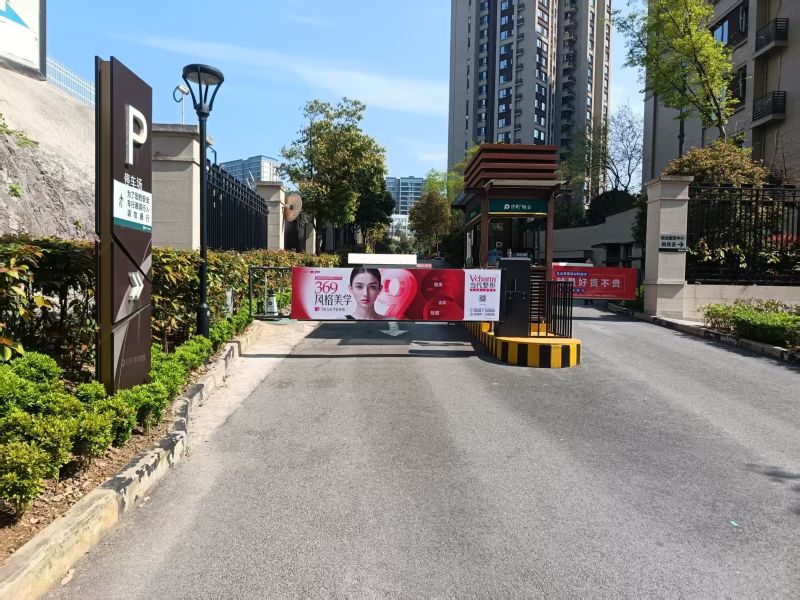
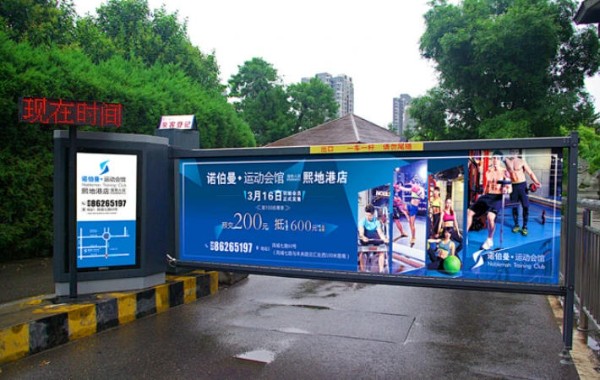
Located at the entrance and exit of the vehicle, it is a must pass for the owner's family. The screen size is large (usually 3 meters by 2 meters or more), with strong visual impact. Suitable for brands targeting families with cars, high-end consumer goods, real estate, tourism, etc.
Advantages: Mandatory viewing, atmospheric visuals, good brand image. Disadvantage: It only covers the driving crowd and has a short viewing time (about 3-5 seconds).
2. Community access control
Located at pedestrian entrances and exits, covering all pedestrians entering and exiting. Including pedestrian barrier advertisements, access control bar advertisements, etc. Suitable for fast-moving consumer goods, lifestyle services, community commerce, etc.
Advantages: Covering all residents, close contact, and interactive QR code scanning. Disadvantage: The screen size is small and easily overlooked.
3. Elevator frame/elevator screen
Located inside the elevator, covering all residents who use the elevator. The elevator frame is a static image, and the elevator screen is a dynamic video. Suitable for brands, new product introductions, and promotional information that require in-depth communication.
Advantages: Forced viewing in enclosed spaces, long dwell time (average 30-90 seconds), and can carry more information. Disadvantage: Some old residential areas lack elevators or advertising spaces.
4. Community bulletin board
Located in the main passage or central square of the community, it is the "bulletin board" of the community. Suitable for public welfare promotion, brand image display, and community activity promotion.
Advantages: Fixed location, long-term existence, and large information carrying capacity. Disadvantage: The attention rate is lower than that of barrier gates and elevator media, making it easy for residents to turn a blind eye to it.
5. Express lockers/pick-up points
Located on the body of the express delivery cabinet or the wall of the pickup point, covering high-frequency online shoppers. Suitable for e-commerce platforms, fast-moving consumer goods, and new retail brands.
Advantages: Reaching young people, focusing attention when picking up items, and can guide scanning and repurchasing. Disadvantage: Short viewing time and easy occlusion of the image.
6. Community activities and ground promotion
Promote through offline activities such as free sample distribution, parent-child activities, and health lectures to achieve interactive communication. Suitable for brands that require in-depth experience and new brands entering the market.
Advantages: Strong interactivity, direct collection of user feedback, short conversion path. Disadvantage: High execution cost, property approval required, limited coverage of people.
Professional community placement is not about choosing a single media, but about combining "barrier gates+elevators+access control" based on budget and goals to form a three-dimensional reach, allowing residents to be surrounded by brand information from entering the community to returning home.
Step 4: Creative Design - Customize Content for "Life Scenarios"
The creative logic of community advertising is quite different from that of business circle media or Internet advertising.
1. Dialogue with real-life scenarios
Good community advertising should be like "recommendations from neighbors" rather than "sales from strangers". For example, placing an advertisement for hot pot ingredients in an elevator can say, "Are you tired from overtime? I'm going home tonight to cook hot pot; Placing home advertisements at the barrier gate can say 'stay at home on weekends, eat well'.
2. Minimalist information, visually prominent
Whether it's the 3-second barrier or the 30 second elevator, residents are not "focused on watching advertisements", but "taking a glance by the way". Therefore, the image must have clear priorities: the brand logo should be large, the core selling points should be few (preferably one sentence), and the colors should jump.
3. The call to action should be specific
If you need to guide scanning, you can't just say 'scan the code to learn more', but also provide specific benefits: 'scan the code to receive exclusive discounts for the community', 'scan the code to book a free car wash'. The more specific the interests, the higher the willingness to scan the code.
4. Consider the degree of environmental integration
The white image is clear in a bright elevator, but may not be clear at a dim gate. Before production, the lighting conditions of the media location should be surveyed on site, and brightness and contrast should be adjusted if necessary.
5. Series design strategy
If multiple elevators or barriers are installed in a residential area, it is possible to consider designing a series of images (such as different family member scenes, different usage scenarios), which can avoid aesthetic fatigue and deepen memory through repeated changes.
Step 5: Effect monitoring and attribution analysis
The evaluation of the effectiveness of community advertising requires the establishment of a multidimensional attribution system.
1. Exposure data
Estimate the total exposure based on the number of households in the community and the daily average frequency of entry and exit. The basic exposure is usually calculated based on "number of households x 2.5 people x frequency of entry and exit".
Pay attention to distinguishing between "passing through" and "watching". Barrier gate advertisements can refer to "vehicle traffic records", and elevator advertisements can refer to "elevator operation times".
2. Brand search index
Monitor the changes in brand keywords on Baidu and WeChat indices during the advertising period. The first wave of effect of community advertising often manifests as an increase in search volume, especially for new brands or products.
3. QR code scanning data
Setting different QR codes or short links for different communities, directly calculating the scanning volume, landing page visits, and retention volume, can calculate the conversion efficiency of each community.
4. Changes in customer flow to the store
For brands with physical stores, LBS data can be used to compare the changes in customer flow between stores in the surrounding areas of the advertising community and those in the non advertising areas, in order to evaluate the effect of advertising on attracting customers to the stores.
5. Sales data association
For brands with community group buying and online e-commerce channels, the sales data changes before and after placement, as well as between the placement community and the control community, can be compared. This is the most direct way to evaluate ROI.
6. Questionnaire survey
Intercept the survey in the community and ask 'What brand advertisements have you seen in the community recently?' to evaluate the recall and preference of the advertisements.
3、 Five common misconceptions in community advertising promotion
Misconception 1: Only looking at the number of households, not matching the population
The community with the highest number of households does not necessarily have the highest value. A 5000 household old residential area may not be suitable for trendy digital products if the residents are mainly elderly; A sub new community with 2000 households, if it gathers a large number of young families, is actually the best choice for mother and baby brands. We must adhere to the principle of "crowd matching first".
Misconception 2: Creativity is not adapted to the local environment
Many brands directly bring the outdoor brand images intact into the community, only to find that no one is watching them at all. Community advertising requires "language that is relatable to daily life" rather than "advertising language". Effective creativity in core business districts may completely fail in community settings.
Misconception 3: Neglecting property communication and maintenance
The installation, maintenance, and replacement of community advertisements require the cooperation of property management. If communication is not smooth, there may be situations where the screen is damaged and unattended, obscured by small advertisements, or even torn off. Choosing a professional platform such as Tianci Media can avoid these execution level pitfalls.
Misconception 4: One time advertising without continuous operation
Some advertisers don't care about it after a month of investment and don't analyze which community has better results. The correct approach is to regularly monitor data, continue to invest in communities with good results, replace or adjust ideas for communities with poor results, and continuously optimize. Community advertising is a 'slow work, fine work' that requires time to settle.
Misconception 5: Underestimating the interference of "environmental noise"
If there are 5 billboards hanging on the gate of a residential area at the same time, or if the elevator is filled with various small advertisements, the advertising effect of a single brand will be severely diluted. When inquiring, it is necessary to understand the media's "exclusivity" policy - whether only one brand is placed in one location, or multiple brands are rotated.
4、 The Future Trends of Community Advertising Promotion
With the development of technology and changes in consumer habits, community advertising is undergoing a new round of evolution.
Digital transformation is accelerating. Traditional framework advertising is being replaced by electronic screens, which can achieve remote magazine changes, time-based delivery, and dynamic content display. In the future, there may be time-based advertising that promotes breakfast in the morning, services during the day, and family consumption at night.
Popularization of data-driven monitoring. Smart screens with sensors can count the number of viewers, duration of stay, and even analyze the age and gender of viewers through desensitized cameras, achieving truly measurable effects.
Interactive experience upgrade. By combining NFC, Bluetooth beacons, and mini programs, residents can use their mobile phones to touch advertisements to obtain coupons or participate in interactions, turning passive viewing into active participation.
Connect private domain traffic. Community advertising is combined with brand private domain operation to guide residents to join the community, pay attention to the official account, and transform "passers-by" into "accessible users".
For brands, this means that community advertising will evolve from "media purchases" to "data assets" and "private domain entrances", and professional platforms like Tianci Media will play a key role in resource integration and data empowerment in this evolution.
5、 Conclusion
Community advertising, seemingly a branch of traditional outdoor media, is actually the "last mile" for brands to establish a deep connection with household consumers.
It is not just a simple "buy a card, stick a picture", but a systematic engineering involving crowd insight, spatial analysis, media combination, creative customization, and data attribution. When your brand information appears on the inevitable path of your target family every day, when they remember your slogan for tens of seconds while waiting for the elevator, and when they subconsciously pick up your product in front of the supermarket shelf - the value of community advertising is truly realized.
In the era of fragmented media, the ability to "meet users every day" in a real-life scenario is a scarce skill. For advertisers who pursue long-term brand value and the household consumption market, community advertising is still a high-quality asset worth investing in.
The key is to use professional methods to do the right advertising.