The entire process of elevator advertising placement: a complete practical guide from 0 to 1
2026-03-04Tianci MediaViews:131
Highlights
What are the steps involved in the entire process of elevator advertising placement? This article completely breaks down 8 core steps from requirement analysis, point selection, creative design, publication execution to effect review, and comes with a guide to avoiding pitfalls. Tianci Media, a professional elevator advertising platform, provides you with one-stop full process services from strategy to review!
When you first prepare to place an elevator advertisement, you are not only faced with the question of which screen or community to choose, but also with a whole process that you have never encountered before: how to set goals? How to choose a location? How to create creativity? How to sign a contract? How to ensure effectiveness?
For beginners, these steps are interrelated, and a single mistake may affect the overall effectiveness of the advertising campaign. This article will provide you with a complete breakdown of the entire process of elevator advertising placement, from early preparation to later review, covering every key node. With this guide, you can independently complete a standardized elevator advertising placement.
1、 The three core preparations before advertising
There are three essential preparations before officially launching the advertising process. They determine the direction and efficiency of all subsequent steps.
1. Clearly define the advertising target
What effect do you hope to achieve through elevator advertising? Is it to enhance brand awareness or to attract traffic to offline stores? Is it a warm-up for the launch of new products or a long-term image maintenance? The goal determines the media format, location selection, and creative direction.
Common target types:
Brand exposure type: Pursuing broad recognition, choosing the framework or smart screen of core communities and office buildings
Promotion driven: Pursuing instant conversion, choosing media such as community barriers and access control that are closest to home
New product launch type: Pursuing topic heat, choosing intelligent screen dynamic display, combined with creative interaction
2. Define the target audience
Who are your target customers? What level of community do they live in? In which region are you active? What are the age, income, and family structure? A clear portrait of the crowd can help you accurately choose your advertising location.
For example, the audience of children's training institutions is families with children, and they should target the surrounding communities of the school district; The audience of high-end car brands is high net worth individuals, and priority should be given to covering villa areas and high-end apartments.
3. Define the budget range
The cost of elevator advertising varies greatly depending on the city, community level, media format, and placement period. Defining a budget in advance can help make reasonable choices in subsequent steps and avoid overspending. Meanwhile, the budget also determines the number of locations you can cover and the delivery cycle.
2、 Eight Steps to the Core of Advertising
Step 1: Media Form Selection
Elevator advertising is mainly divided into two categories, and the most suitable form is chosen based on the target audience.
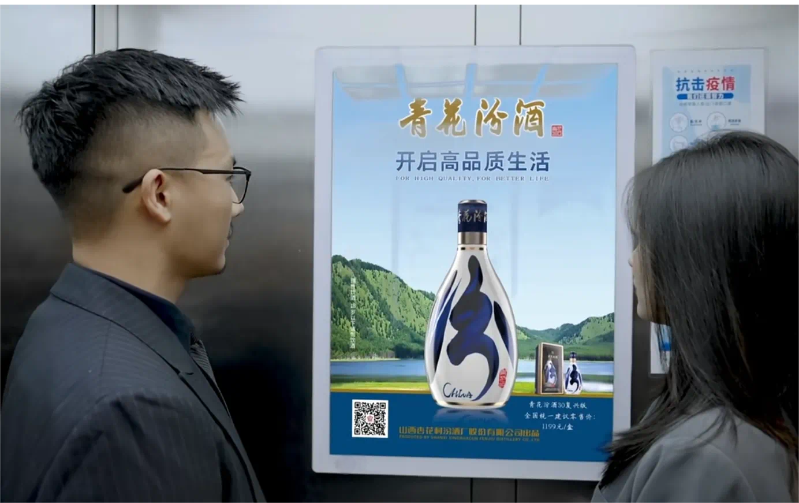
Elevator frame advertisement: Static poster, low production cost, visible 24 hours a day. Suitable for brand image display and long-term information transmission, with high cost-effectiveness.
Elevator intelligent screen advertisement: dynamic video, combined with sound and image, can be remotely changed. Suitable for scenarios such as new product launches and promotional activities that require quick attention grabbing, with stronger interactivity.
Elevator door advertisement: Large area, strong visual impact, located on the opening line. Suitable for brand image blockbusters or creative designs that complement holiday themes.
Combination strategy suggestion: For brands with sufficient budget, a combination strategy of "framework breadth+intelligent screen depth" can be adopted to achieve three-dimensional coverage.
Step 2: Point selection and community evaluation
This is the core and most time-consuming step in determining the effectiveness of advertising.
Point evaluation dimension:
Community level: housing prices, property fees, occupancy rate, self occupancy ratio
Population matching degree: whether the age structure and family composition of residents are consistent with the target audience
Location quality: elevator location (main/auxiliary elevator), visibility of advertising space, presence or absence of obstruction
Surrounding environment: commercial facilities around the community, with or without competitor advertisements
Field survey: No matter how beautiful the data is, it's not as good as taking a field trip. Choose different time periods (morning and evening rush hour, weekends) to go to the entrance of the target community, feel the flow of people, observe the entry and exit status of residents, and view the quality of existing advertisements.
Utilizing professional expertise: self screening is inefficient and lacks transparency in information. Tianci Media is a professional elevator advertising platform with a community building database covering major cities across the country. It can quickly output a list of matching properties based on your goals.
Step 3: Obtain a quotation and compare it with the proposed solution
Inquire with 2-3 qualified elevator advertising companies to provide your advertising needs (region, community type, format, duration) and obtain detailed pricing plans.
When inquiring, it is necessary to clarify:
Does the price include tax?
Does it include the cost of image production and installation?
How long is the advertising cycle? Can it be flexibly adjusted on a weekly/monthly basis?
Do you provide publishing and broadcasting monitoring services?
Who is responsible for maintaining the visuals during the contract period? Repair time for damage?
Scheme comparison: Don't just compare the total price, but also compare the quality of the points, service content, and the authenticity of the resources. A standardized quotation plan should include key information such as the name of the property, specific address, community level, advertising format, monthly single point price, total package price, and expected occupancy rate.
Step 4: Creative Design and Production
The creativity of elevator advertising has its unique rules. Passengers stay in the elevator for a short time (usually 30-60 seconds), the environment is closed, and their attention is easily focused but also easily distracted.
The Three Principles of Creativity:
Brand identity should be big: let people know who you are at a glance
The core message should be short: clearly state the benefits you can bring in one sentence
Action instructions must be clear: QR codes, phone numbers, and addresses must be prominent and easy to remember
The "Three Second Rule": It takes an average of 3 seconds from raising your eyes to lowering your head, and you must convey three things within 3 seconds - who you are, what you sell, and what concerns me.
Production requirements:
Elevator frame advertisement: High precision printing files (above 300dpi, CMYK mode) are required
Elevator intelligent screen advertisement: Video files that meet technical specifications (resolution, format, duration) must be provided
Production cycle: usually takes 3-7 days, with longer reserved for video content
Step 5: Contract Signing and Rights Protection
After confirming the plan, sign a formal contract with the media. The contract content should include the following key clauses:
Details of advertising locations: community name, elevator number, media format, specific location
Starting and ending time of advertising: precise to the start and end dates of days
Cost breakdown: Media release fee, production fee, installation fee, taxes, itemized list
Payment method and time: down payment ratio, final payment node
Rights and obligations of both parties: responsibility for maintaining the image, time limit for repairing damages, and handling of force majeure
Liability for breach of contract and dispute resolution: Clarify the circumstances of breach and compensation standards
Special attention: Time commitment for publication, response time for screen replacement, compensation plan for ads that cannot be displayed properly due to malfunctions.
Step 6: Publication Execution and Monitoring
After the agreed publication time in the contract arrives, it enters the execution stage.
Confirmation before publication:
Has the production of the visuals been completed on time
Is the installation team in place
Do you need to confirm the entry time with the property management
Publication monitoring: Media outlets are required to provide publication photos or videos with watermarks of time and location to ensure that advertisements are displayed as agreed. If conditions permit, one can conduct random sampling to verify the authenticity of the monitoring report.
The monitoring content should include:
The advertising screen is complete and undamaged
The installation location is consistent with the contract
The lightbox lights up normally (if applicable)
Smart screen playback is normal
Step 7: Effect tracking and data collection
Advertising is not the end, but the beginning of effectiveness verification.
Tracking method:
Direct feedback: Set up exclusive QR codes, discount codes, or phone extension numbers to track the number of inquiries and conversions from this channel
Brand research: Conduct small-scale questionnaire interviews in the advertising community to understand advertising awareness
Online data: Monitor the search index changes of the brand in the target area during the advertising period
Sales data: Compare the sales changes of surrounding stores during the advertising period and evaluate the actual driving force of advertising on business
Data collection cycle: It is recommended to collect data once a week to promptly identify issues and adjust strategies.
Step 8: Effect Review and Optimization
After the end of the advertising cycle, conduct a comprehensive review to accumulate experience for the next advertising campaign.
Review dimension:
Exposure data: actual coverage and exposure frequency
Interactive data: QR code scanning volume, coupon redemption volume, consultation volume
Conversion data: in store customer flow, changes in sales revenue, and proportion of new customers
Cost data: actual expenses, cost per thousand people, customer acquisition cost
Optimization direction:
Communities with good positioning effects may consider continuing or increasing investment
Reasons for ineffective point analysis (mismatched audience, creative issues?)
Adjust the media mix and cycle for the next advertising campaign based on data
3、 Common Misconceptions and Avoiding Pits Guide
Misconception 1: Skip preliminary analysis and directly inquire about prices
Many beginners ask 'How much does elevator advertising cost per yuan' as soon as they come up, but they can't tell who their target audience is. This will result in the media being unable to recommend suitable locations, ultimately leading to a pile of invalid quotes.
The correct approach: First, take the time to clarify your target audience and advertising objectives, and then inquire with clear needs.
Misconception 2: Only focusing on price, ignoring the quality of the location
The lowest priced locations are often located in communities with low occupancy rates and populations that do not match the target, which may seem cost-effective but is actually a waste. The quality of the crowd is far more important than the unit price.
Misconception 3: Creative "one size fits all" approach, where one set of materials is invested in all
The characteristics of different communities' populations are different, and creativity should also be differentiated. High end communities require style, ordinary communities require affinity, and school district housing can highlight educational elements. If conditions permit, creative ideas can be customized for key communities.
Misconception 4: Underestimating production cycle and cost
From creative design to document delivery, and then to production and installation, it usually takes about a week. If you want to rush into marketing, it is important to plan ahead and reserve sufficient time.
Misconception 5: After signing the contract, 'letting go' and ignoring monitoring and broadcasting
If not monitored in a timely manner after publication, there may be situations such as missed or incorrect submissions, and damaged images, which can affect the effectiveness of advertising. It is necessary to request a monitoring report or conduct self inspection.
Misconception 6: Only investing without testing, no effect tracking
It is unrealistic to wait for the effect to come by oneself after casting. A tracking mechanism must be established to guide the next delivery with data.
Misconception 7: Collaborating with unqualified intermediaries
Elevator advertising resources are scattered, and there are a large number of personal intermediaries in the market. Cooperating with unqualified intermediaries may face risks such as false location, opaque prices, and lack of guarantee for publication. It is recommended to choose a legitimate advertising company, such as Tianci Media, to ensure that the advertising is legal and compliant.
4、Conclusion
The entire process of elevator advertising placement may seem complex, but as long as you master the core steps, you can proceed in an orderly manner: from goal setting to targeted screening, from creative production to publication execution, from effect tracking to review and optimization, each step has its own rules to follow.
For beginners, it is recommended to start with small-scale testing: choose 1-2 communities that are highly matched with the target audience, advertise for a quarter, and track the effectiveness through dedicated channels. On the basis of data support, gradually scale up the scale.
Tianci Media is a professional elevator advertising platform that has been deeply involved in elevator media for many years. It has a vast collection of building resources and rich advertising experience covering the whole country. We provide one-stop full process services from demand analysis, point recommendation, price negotiation to creative design, publication execution, and effect tracking. Make every elevator advertisement you place a starting point for efficient dialogue between your brand and target users.