Introduction to Advertising Three Piece Set in Aircraft Cabin: Targeting Top Attention at Ten Thousand Miles High Altitude
2026-02-09Tianci MediaViews:117
Highlights
This article is an introductory guide to the three piece advertising set for airplane cabins, detailing the positioning, creative points, and high-end advertising strategies of the three core media: header, tabletop, and safety notice card. If you need professional in-flight advertising services, Tianci Media, as a professional aircraft advertising placement company, can provide integrated solutions.
When the plane enters the stratosphere, the mobile network temporarily "malfunctions" and passengers' attention returns from the digital world to reality. At this moment, the limited physical space inside the cabin has become an excellent stage for brands to communicate deeply with high net worth individuals. The commonly referred to "three piece airplane cabin advertisement" in the industry refers to the three irreplaceable protagonists on this stage: seat headpiece advertisement, small table board advertisement, and safety notice card advertisement. Why is this combination so important for brands that are new to aviation media? What kind of magic does it have? This article will unveil this mysterious veil for you and guide you through how to use this "high-altitude matrix" to accurately land brand information in the cloud.
Part 1: Decoding the "Three Piece Set": Definition and Irreplaceable Gold Value
What is a 'cabin three piece set advertisement'?
This is an industry term that specifically refers to the combination of three classic advertising carriers that cover the visual and tactile core flow of passengers in civil aviation cabins:
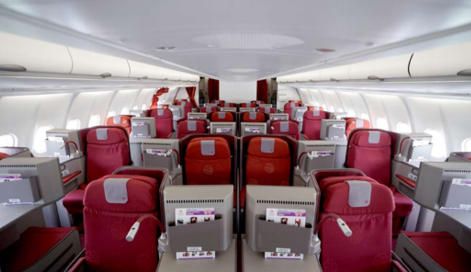
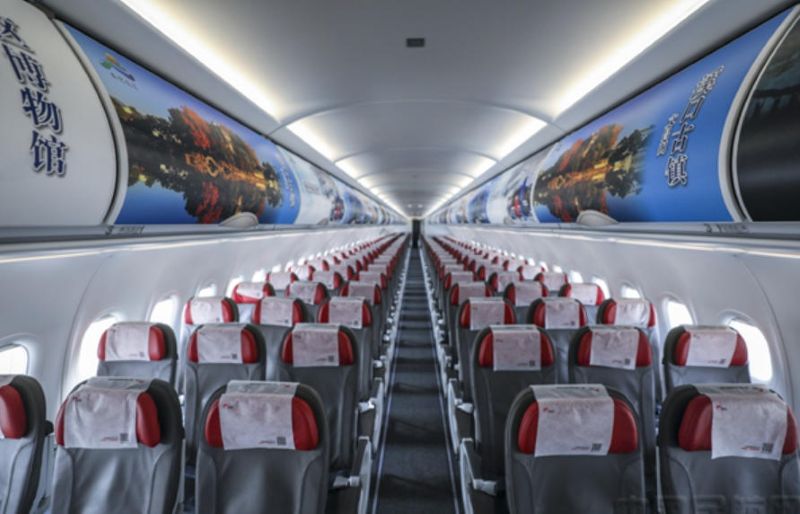
Seat headpiece advertisement: located above the magazine pocket behind the front seat or behind the front seat, it is the absolute focal point of the passenger's field of view directly in front after sitting down.
Small table board advertisement: located on the back of the small table board in front of passengers, it will inevitably unfold and be seen when passengers are dining, working, or placing items.
Safety Notice Card Advertisement: Located in the seat back pocket, merged or adjacent to the safety notice card, passengers may retrieve it multiple times throughout the flight.
These three together form a complete communication loop from "first glance" to "frequent contact".
Why is it priceless? Three core advantages
The value of the "three piece set" combination is rooted in the unique scenario of air travel:
Top audience value: Airplane passengers are mainly composed of business people, mid to high end tourists, study abroad families, and visiting relatives and friends. They generally have the "three highs" characteristics of high income, high education, and high consumption power, and are the dream customers of luxury goods, automobiles, finance, high-end tourism, study abroad education, and other industries.
High concentration and closure of attention: During an average flight of over 1 hour, the cabin is a closed environment without signal interference. Passengers are in a "semi boring" waiting state, with a peak sensitivity and acceptance of surrounding environmental information, and an extremely high advertising reading rate.
Deep communication and forced contact: The "three piece set" occupies the necessary actions for passengers to "see", "use", and "flip", achieving mandatory and repetitive deep contact. Especially for the small table board and security card, the contact time is long and the information transmission is deeper.
Part 2: Disassembling the "Three Piece Set": Their Characteristics and Creative Methods
1. Seat headpiece advertisement: the "aerial facade" of brand image
Visual positioning: The unavoidable "first screen" directly in front of the passenger's field of view.
Viewing timing: Upon boarding, sitting down, and looking up during flight.
Creative core:
Ultimate visual aesthetics: The image must be high-definition, exquisite, stylish, and in line with high-end brand tone.
Extremely concise information: highlighting the brand logo and a core slogan is enough, avoiding information stuffing.
Theme atmosphere creation: often combined with themes such as destination tourism and high-end lifestyle.
2. Small Table Board Advertising: An Interactive Stage for Deep Persuasion
Visual positioning: The center of the passenger's private use space, with a large area and strong visual impact when unfolded.
Timing of viewing/use: Facing for extended periods of time during dining, office, or entertainment.
Creative core:
Carrying more information: suitable for telling short brand stories, showcasing product lines or complex features.
Strong interactivity and practicality: can be designed as simple board games, destination maps, knowledge tips, etc., to increase fun and retention time.
Guiding action: clear website and WeChat official account QR code can be printed to facilitate passengers' instant interaction after connecting to Wi Fi.
3. Safety Notice Card Advertisement: "Trust Endorsement" Accompanying Throughout the Process
Visual positioning: Placed in the safety notice booklet, it comes with "official" and "important" trust attributes.
Timing of viewing: During pre takeoff safety demonstrations or during boring flight browsing.
Creative core:
Clever integration, without overshadowing others: The design needs to coordinate with the style of the safety notice card itself, ensuring that safety information is clear and primary.
Deep reading may: Passengers have a more serious attitude when browsing, and can provide more in-depth product introductions or discount details.
Long term retention value: Some passengers may take away their collections, extending the advertising lifecycle.
Part 3: Beginner's Four Step Method: Plan Your First High Altitude Launch
Assuming you are an international luxury hotel group looking to enhance brand awareness among Asian business travelers.
Step 1: Clarify the target and audience portrait
Core objective: To attract high-end business travelers who frequently travel between major cities in the Asia Pacific region and enhance the brand's first choice among the target audience.
Audience portrait: aged 30-55, corporate executives, professionals, with an average of over 10 flights per year.
Placement orientation: Brand image shaping as the main focus, with consideration given to member recruitment.
Step 2: Strategically match routes with airlines
Route selection: Priority should be given to Asia Pacific core business routes such as Beijing Shanghai Hong Kong Singapore and Shanghai Tokyo.
Airline selection: Choose flights from full-service airlines known for their high-quality services, such as Air China, China Eastern Airlines, Singapore Airlines, Cathay Pacific, etc., whose cabin environment is more in line with the quality of the audience.
Cabin selection: Focus on business class and super economy class, directly reaching the core target customer group.
Step 3: Creative planning for the "three piece set" combination
Headline advertisement: Display a corner of the hotel's iconic building or suite, accompanied by simple text such as "A peaceful harbor above the clouds".
Small table advertising: Display the hotel's distribution map in the Asia Pacific region and highlight business features such as "airport shuttle" and "24-hour executive lounge".
Security card advertisement: The inner page can be designed as an invitation to join, accompanied by an exclusive application QR code and a promise of "book now and enjoy exclusive in-flight benefits".
Step 4: Professional Execution and Effect Tracking
Professional cooperation: strict approval process for aviation media, special production techniques (such as fire-resistant materials), and complex publication process. It is necessary to cooperate with professional organizations, such as Tianci Media, which is a professional aircraft advertising placement company. They have a mature airline cooperation network and execution experience, which can ensure the smooth progress of the entire process from scheme approval, special material production to cross airline publication.
Effect evaluation: Design exclusive "on-board identification codes" or landing pages, track traffic and conversion from advertisements to official website booking pages, and evaluate the effectiveness of advertising.
Part 4: Three Misunderstandings in Advertising that Must Be Vigilant Against
Misconception 1: Simply "moving" ground advertising. Directly apply advertising designs with strong colors and dense information used for subways or buildings to the cabin. The high-altitude environment requires a more elegant, peaceful, and textured visual language, and overly stimulating designs can cause passenger aversion.
Misconception 2: "Fight alone" instead of "combination boxing". Only release the first film, thinking that the maximum exposure is enough. This wastes valuable opportunities for deep communication and action guidance with the small table board and security card. The synergistic effect generated by the combination of the "three piece set" is much greater than that of a single form.
Misconception 3: Neglecting the tone matching between airlines and cabin seats. If a top luxury brand is placed in economy class on low-cost airlines, it will cause serious brand image distortion. It is necessary to ensure that the media environment is highly consistent with the brand level.
Step 5: Professional Value: Why do you need a high-altitude companion?
Coordinating multiple airlines independently, understanding the different advertising standards of each airline, and completing the production of special materials that meet aviation safety standards is a huge challenge for brand owners.
The core value of collaborating with professional companies like Tianci Media lies in:
Strategy and resource integration: Based on your goals, provide the best combination strategy of route airline cabin, and integrate multiple resources to provide one-stop procurement.
Professional compliance guarantee: Proficient in all special requirements of aviation advertising, ensuring full compliance, safety, and efficiency in creative design, material production, and publication installation.
Efficiency and cost optimization: By scaling and specializing operations, you can save on negotiation and management costs, allowing you to focus more on the marketing strategy itself.
Conclusion: In the cloud, complete an elegant brand dialogue
The success of the three piece airplane cabin advertisement lies in its ability to go beyond simple "viewing" and achieve "coexistence" and "dialogue" with high-end audiences in a specific time and space. It is a test of the overall strength of a brand - from precise strategy, creative style, to rigorous execution.
For beginners, it is recommended to start with a precisely defined niche market (such as two specific business routes), use a carefully designed "three piece set" combination for pilot advertising, and strictly track conversion. After verifying the unique influence of this high-altitude channel on the target customer group, you can confidently expand this brand's position to a broader route network, making your brand a trustworthy and desirable symbol at an altitude of tens of thousands of meters.